
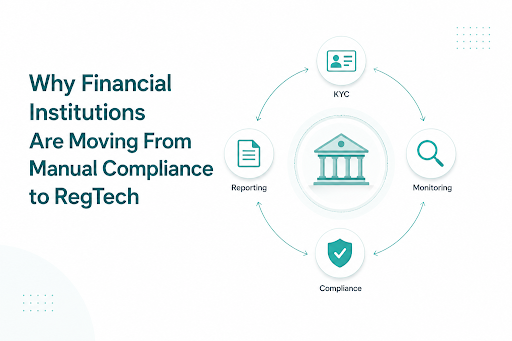
Financial compliance is becoming harder to manage through manual processes alone. Financial institutions now operate across multiple regulatory frameworks, handle growing transaction volumes, and need to maintain accurate evidence for audits and reporting. At the same time, compliance teams are expected to respond faster to regulatory changes without allowing costs and operational workloads to grow at the same pace.
This is where regulatory technology, or RegTech, is becoming increasingly important. Instead of relying on disconnected spreadsheets, repetitive reviews, and manual reporting, institutions can use technology to automate recurring compliance activities, connect data, and improve monitoring. Modern RegTech software development is helping financial businesses build compliance capabilities that can scale alongside their operations.
Table of Contents
Why Manual Compliance Is Becoming Difficult to Scale
Manual compliance processes may work when transaction volumes and regulatory requirements are limited. As institutions grow, however, several structural problems begin to appear.
1) Multi-Framework Overlap
Financial institutions rarely operate under a single set of regulatory requirements. Different products, markets, jurisdictions, and customer segments can introduce overlapping obligations. Teams must determine which requirements apply, track changes, and ensure that internal controls remain aligned.
Managing these requirements manually increases the possibility of missed updates and inconsistent execution.
2) Volume and Complexity
The number of customers, transactions, documents, alerts, and regulatory records can grow rapidly. Reviewing each item manually creates a significant operational burden and makes it difficult for compliance teams to focus on higher-risk cases.
3) Inconsistent Cadence
Some compliance activities happen continuously, while others follow daily, monthly, quarterly, or event-driven schedules. When these activities depend heavily on manual reminders and spreadsheets, important checks can become inconsistent.
4) Fragmented Evidence
Compliance evidence is often distributed across banking platforms, customer databases, email, spreadsheets, document repositories, and internal systems. Finding the right information during an audit can therefore become a time-consuming exercise.
The result is a compliance function that spends too much time coordinating information instead of analyzing risk.
What is RegTech and Why Does It Matter?
RegTech refers to the use of technology to help organizations manage regulatory and compliance requirements more efficiently. It can combine automation, data integration, analytics, APIs, workflow management, and artificial intelligence to support compliance operations.
The important shift is not simply from paper to software. It is from manual compliance activities to connected and increasingly continuous compliance processes.
Instead of employees repeatedly collecting information, checking records, preparing reports, and tracking regulatory updates, RegTech can automate defined workflows and surface information that requires human attention.
This allows compliance teams to spend less time on repetitive administrative work and more time on investigation, judgment, risk management, and oversight.
Where RegTech Can Reduce Manual Compliance Work
RegTech can support several areas where financial institutions traditionally depend on repetitive manual processes.
1) Transaction Monitoring & Financial Crime
Transaction monitoring is one of the most resource-intensive areas of financial compliance. RegTech can continuously analyze transaction activity, identify unusual patterns, generate alerts, and route cases to the appropriate teams.
This does not eliminate human investigation. Instead, it helps compliance professionals focus their attention on transactions and customers that present higher levels of risk.
2) Reporting & Data Management
Regulatory reporting often requires information to be collected from multiple systems and transformed into specific formats. Automated workflows can help consolidate data, apply validation rules, identify missing information, and prepare reports.
Better data management also creates a more consistent source of compliance evidence and reduces the dependency on manually maintained spreadsheets.
3) Identity Verification & Onboarding
Customer onboarding can involve identity verification, document checks, screening, risk assessment, and ongoing due diligence. RegTech can automate portions of these workflows, allowing institutions to process customers more efficiently while applying standardized compliance controls.
4) Regulatory Tracking and Horizon Scanning
Regulations do not remain static. Financial institutions need to identify relevant regulatory developments and determine how changes affect their policies, controls, and processes.
RegTech can support regulatory tracking and horizon scanning by monitoring relevant updates, categorizing changes, and directing them to the teams responsible for assessing their impact.
From Compliance Tools to RegTech Infrastructure
RegTech is increasingly moving beyond isolated compliance applications. Its value becomes greater when compliance capabilities are connected with the broader financial technology environment.
A modern RegTech architecture may integrate with core banking systems, payment platforms, CRM systems, customer databases, transaction-processing systems, data warehouses, and reporting platforms.
APIs and data integration allow compliance information to move between these systems rather than remaining trapped in separate tools. This can create a more connected compliance environment where customer information, transactions, risk indicators, and reporting evidence can be accessed through consistent workflows.
As a result, RegTech can become part of the underlying infrastructure supporting financial operations rather than simply another application used by the compliance department. This broader shift is also reflected in the growing role of RegTech infrastructure within modern fintech architecture.
How AI is Changing RegTech
Artificial intelligence is adding another layer of capability to RegTech by helping systems identify patterns, prioritize risks, and process large volumes of information.
1) Intelligent Risk Detection
AI can analyze large datasets to identify unusual behaviors and patterns that may be difficult to detect through fixed rules alone. This can support risk scoring and help compliance teams identify potentially significant cases.
2) Dynamic Transaction Monitoring
Traditional monitoring often relies heavily on predefined rules. AI can complement those rules by analyzing behavioral patterns and identifying anomalies that may require further investigation.
3) Smarter Alert Prioritization
Large compliance operations can generate substantial numbers of alerts. AI can help prioritize alerts based on risk indicators, reducing the amount of time teams spend reviewing low-value cases.
4) Automated Regulatory Intelligence
AI can assist with processing regulatory documents, identifying relevant changes, extracting requirements, and connecting those changes to internal compliance processes.
5) Human Oversight and Explainability
AI does not remove the need for compliance professionals. Financial institutions still need governance, explainability, validation, and human oversight, particularly when automated systems influence risk decisions.
The strongest RegTech implementations therefore combine automation with clearly defined human controls rather than treating AI as a replacement for compliance judgment.
Business Benefits of Moving From Manual Compliance to RegTech
Moving from manual processes toward RegTech can create several operational benefits.
Reduced compliance workload: Automation can handle repetitive data collection, verification, monitoring, and reporting activities.
Faster compliance operations: Automated workflows can reduce delays caused by manual handoffs and repeated data entry.
Better data consistency: Connected systems reduce the risk of conflicting information across compliance processes.
Improved audit readiness: Centralized records and traceable workflows make it easier to demonstrate how compliance activities were performed.
Greater scalability: Technology can help institutions manage increasing customer and transaction volumes without increasing manual effort at the same rate.
Lower operational costs: Reducing repetitive work can allow compliance teams to allocate resources toward higher-value risk and investigative activities.
The real benefit, however, is not simply cost reduction. It is the ability to build a compliance operating model that can adapt as regulatory requirements and business volumes change.
What Financial Institutions Should Consider Before Adopting RegTech
RegTech adoption should begin with the compliance process rather than the technology itself.
Financial institutions should first identify where manual work creates the greatest operational risk or inefficiency. They should then evaluate data quality, integration requirements, security, privacy, scalability, and regulatory obligations.
Legacy-system integration is another important consideration. A RegTech platform that cannot reliably connect with existing financial systems may create another isolated workflow rather than solving the underlying problem.
Governance also matters. Institutions should establish clear responsibilities for automated decisions, exception handling, model validation, and human review.
The objective should not be to automate every compliance activity. It should be to automate the right activities while preserving appropriate human judgment and oversight.
Conclusion: The Shift From Manual to Continuous Compliance
Financial institutions are moving toward a different model of compliance. Instead of relying primarily on periodic manual checks, spreadsheets, and disconnected evidence, organizations can use RegTech to create more automated, connected, and continuous compliance processes.
The transition is not about replacing compliance professionals. It is about giving them better infrastructure, better data, and better tools to focus on risk and judgment.
As financial businesses modernize their technology environments, compliance capabilities will increasingly need to operate as part of the wider financial technology ecosystem. Working with a capable fintech software development agency can help institutions design and integrate these capabilities around their existing systems and long-term technology strategy.
