
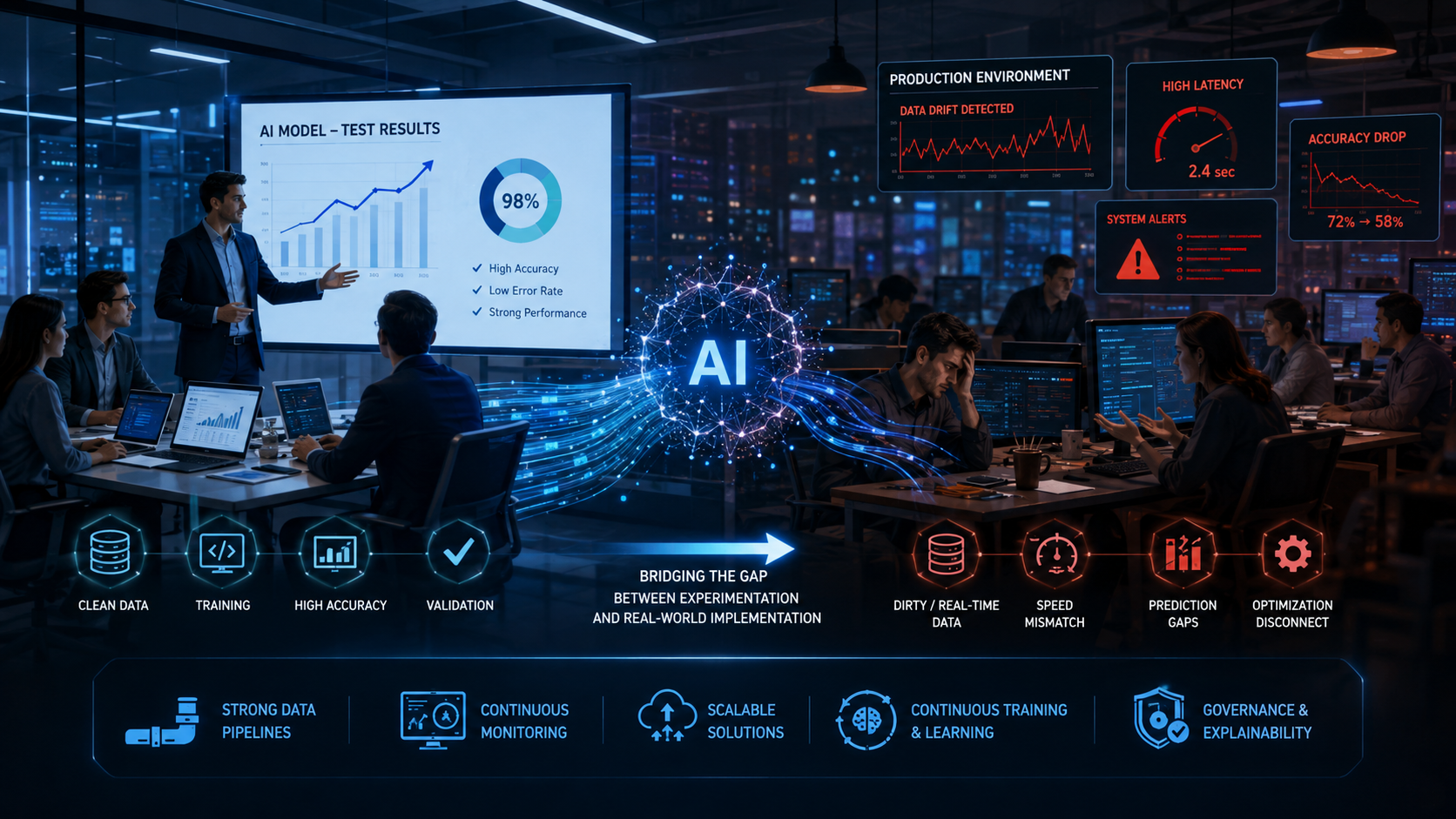
Let’s imagine a real-world scenario wherein an AI model promises to deliver exceptional results in a boardroom presentation, but the same model, when put into practice, delivers inaccurate predictions, resulting in poor performance, rising costs, and loss of trust.
Isn’t it surprising that an AI model that works best in the testing phase fails to perform amidst real-world challenges?
Businesses these days are heavily investing in AI consulting services, expecting to improve their performance, productivity, and profitability.
Therefore, it becomes critical to identify the root causes of AI models breaking in production and how better development can prevent this failure.
Let’s explore some of the key reasons AI models break in production, and then have a look at how better development can fix these gaps.
Table of Contents
Key Reasons AI Models Break in Production
AI models don’t fail because of flawed algorithms; they usually fail because they are unable to perform in realistic production environments, wherein situations are consistently evolving and are far more dynamic and unpredictable. There are several data streams that evolve, and user behaviors shift in real-world production environments; therefore, business priorities change over time. To elaborate further on this subject, below is a detailed explanation of the key reasons AI models break in production.
Data Contradiction
AI models are usually trained on systematic datasets stored as structured CSV files. These datasets are organized, cleaned, and labeled before AI models use them. These datasets are free from duplicate entries, inconsistent formats, and missing values. On the other hand, when AI models are practically implemented, they need to work with real-time data streams fetched from multiple sources like user inputs, IoT devices, APIs, transaction systems, or external databases. Data fetched from different sources lacks uniformity and contains inconsistencies, and therefore, in those situations, AI models fail to respond the way they do during the training phase.
Speed Mismatch
During the training phase, AI models usually work in offline environments, and even if they respond slowly, it doesn’t impact the overall performance of an app or software. On the contrary, in real-time production, predictions are expected to be delivered within milliseconds. This is a speed mismatch between the training and deployment phases. Features that take 10 seconds to deliver results might be required to work within 100 milliseconds when deployed live. For instance, an AI-powered fraud detection system is required to evaluate transactions instantly. If it doesn’t stop a fraudulent transaction from happening within a second, it might not solve the problem. Therefore, without the right speed optimization, even highly accurate AI models can become irrelevant for real-world use.
Prediction Gaps
AI models during their training phase completely use historical data, which includes customer interactions, purchases, and final outcomes. This information is about the events that have already occurred. However, in real-life production, real-time information is required, which is often before events occur. For example, if demand forecasting is done based on historical data, it can fail to be accurate and useful. This creates prediction gaps wherein data used in the training phase is obsolete, which, if used in real-life production, can yield inaccurate predictions leading to unreliable performances.
Optimization Disconnect
In the training phase, AI models are typically optimized for high-end accuracy and predictive performance. This may involve large feature sets, complex algorithms, and computationally heavy processes. However, in real-world conditions, AI models are expected to be fast, scalable, and reliable, besides being accurate. This creates an optimization disconnect as an AI model that performs well in the training phase may be too slow or unreliable for production. In real-life scenarios, AI models are supposed to practice graceful degradation, which means the system should continue functioning even if data sources are scarce or traffic spikes occur to ensure stability and a consistent user experience.
So, now we have learnt about different scenarios and reasons why AI models fail to perform in real-world production. But what do winning AI development companies do differently that not only helps them in fixing these gaps but also ensures that their AI software succeeds in delivering the actual and expected results?
Yes, there are certain AI development tricks that can help you fix these gaps and ensure that you launch highly successful AI models that help you achieve your business goals. So, let’s have a look at these AI model deployment tactics enabling you to prevent failures in real-life scenarios.
AI Model Deployment Tactics: How to Fix the Gaps Between Experimentation and Real-World Implementation
With the right AI deployment tactics, you can transform unrealistic AI experiments into robust, business-critical, and profit-generating systems. Below are some AI model deployment tactics to ensure your AI model performs well and helps you achieve your business goals.
Build Strong Data Pipelines
AI systems work based on data fetched from different sources. This data often has formatting errors, missing values, or inconsistencies. Building a strong data pipeline can help prevent data issues. Incorporating automated data validation checks can help fix errors and formatting problems before they reach the AI model. Also, implementing data cleaning processes can help handle missing values, remove duplicates, and streamline formats to maintain data consistency. Precisely, building strong data pipelines can help an AI model receive fresh, error-free data without delays.
Monitor the AI Model Continuously
Building a successful AI model requires continuous monitoring of its performance; otherwise, it is likely to fail due to changing data patterns, user behavior, or even external market conditions. Without proper monitoring, several issues in the AI model go unnoticed, and you come to know about them after they have already impacted your business outcomes. Continuous monitoring of an AI model helps you learn about how accurate the predictions are, response latency, data drift, and overall system health on a real-time basis. Precisely, it helps in identifying issues in advance, which can help you take corrective actions before damage happens.
Design Scalable Solutions
Technologies are evolving at a breakneck speed. The features that work today may not work tomorrow. So, it is important to design scalable AI models that can handle changing market landscapes, user behavior, and data volumes. AI models that are built for scalability can never slow down or fail, even if traffic spikes or user behavior changes. In short, by designing AI models for scalability from the beginning, businesses ensure consistent performance, faster response times, and reliable AI systems as usage grows.
Ensure Continuous Training and Learning
AI models are likely to lose their effectiveness as the environment and conditions around them change. There are shifts in customer behavior, market conditions, and new data patterns that flow in. If AI models continue to rely on the same rules they were trained on, there is are high chance that their predictions will become obsolete and less accurate. Therefore, it becomes significant to ensure that scheduled retraining is implemented that allows updating models at regular intervals and ensures that they incorporate the latest trends and behaviors. Also, event-driven retraining models can be enforced to detect issues like data drift, accuracy drops, or sudden changes in user behavior.
Prioritize Governance and Explainability
As AI systems increasingly influence important decisions, organizations require ensuring that their AI models are accountable and transparent for their decisions. By maintaining audit trails, tracking data sources and updates, and documenting model versions, it becomes possible for businesses to prioritize explainability and governance. These practices also simplify troubleshooting and improve accountability.
Conclusion: Build AI Models for Real Environments
The success of an AI model is not determined in controlled environments; it is proven in real-world scenarios. Modern businesses are aiming to build sophisticated AI models that practically work in real environments. Issues like inconsistent data, speed mismatches, prediction gaps, and optimization disconnects can quickly undermine even the most advanced AI systems.
The only key to preventing these issues is to build AI models that consider scalability, adaptability, monitoring, and compliance. Strong data pipelines, continuous monitoring, scalable architectures, ongoing retraining, and clear governance frameworks ensure that AI models remain stable, adaptable, and trustworthy in dynamic environments.
To build successful AI models, we need to bridge the gap between experimentation and deployment. All you need to do is partner with the best AI development company that can help you transform AI from a promising concept to a powerful driver of long-term value, performance, and gain a competitive advantage.

