

SaaS GTM has changed more in the last two years than in the five before them. Here’s what the new playbook looks like and what it means for your team in 2026.
In 2021, the average SaaS company spent $1.14 to acquire every dollar of new ARR. In 2026, that number has climbed to around $2.00 for many mid-market players. And it hasn’t stopped.
The math that made the old GTM playbook work is getting harder to justify. That playbook became almost universal between 2018 and 2023:
- Invest heavily in inbound
- Run aggressive outbound sequences
- Build a big SDR team
- Optimize the funnel
- Repeat until growth compounds
It worked for a while until it didn’t. Today, the sheer volume of SaaS products competing for attention in any given category makes differentiation nearly impossible.
What replaced the old playbook in 2026 is a set of sharper, more specific plays that’s less obsessed with volume. All-in-one GTM platforms are part of that shift.
This article breaks down what’s changed in SaaS GTM in 2026, and what the teams pulling ahead are doing differently.
Table of Contents
Why the Old GTM Playbook for SaaS Falls Short Today
SaaS GTM tactics didn’t just get stale. The buyer changed. In 2026, most B2B buyers are well into their decision process before they ever speak to a rep. They’ve read reviews, compared alternatives, and formed a strong opinion about your business before you know they exist.
That narrows the window where GTM motions can meaningfully influence a deal. It also changes where the real work happens. Pipeline today gets won or lost long before the discovery call. So the question is “How do we meet buyers where they already are, and move with them at speed?” Let’s find out.
Play #1: Stop Targeting Everyone. Start Owning a Segment.
The spray-and-hope outbound model now actively damages your brand with the buyers you actually want. Buyers recognize templated sequences in seconds and ignore them just as fast.
The teams pulling ahead have instead chosen to target the right audience with outreach that reflects a keen understanding of their specific situation. And SaaS founders agree:
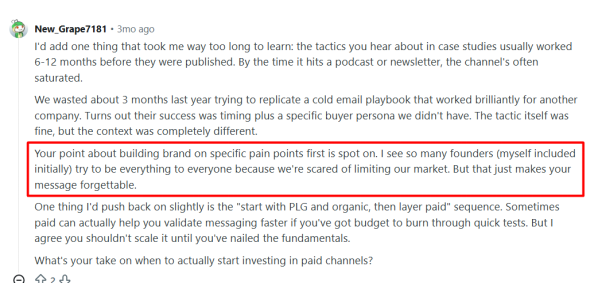
An email referencing a relevant funding round or meaningful tech stack change will always earn attention over generic outreach.
To apply this in practice, you need to build an ideal customer profile (ICP) from closed-won data. Take a close look at your current customer. Find out what triggered them to buy and what their business looked like when they entered the funnel.
Then build your messaging and targeting around the results. HubSpot’s research shows companies with a tightly defined ICP grow 68% faster than those without one.
What this looks like in practice: fewer leads entering the top of the funnel, higher conversion rates throughout, and a sales team spending time on deals with a real chance of closing.
Play #2: Act on Signals While They’re Still Warm
The fixed message cadence in most SaaS teams (emails on days one, three, five, and eight) is giving way to outreach triggered by actual buyer behavior.
A prospect visiting your pricing page, downloading a competitor comparison, or asking a pointed question in a webinar are all high-intent signals. Acting on these signals fast, with a message that reflects what matters to the prospect, beats any pre-programmed sequence.
Case in point, studies show that contacting a lead within the first minute can increase sales conversions by up to 391%. Most teams miss this because their systems aren’t wired to move that fast.
What this looks like in practice: intent data and behavioral signals need to feed directly into your outreach workflows, so your message lands when the buyer’s attention is already on you.
Play #3: Let Product-Led and Sales-Led Motions Run in Parallel
The debate about whether to build a product-led or sales-led GTM motion defined a lot of SaaS strategy conversations between 2019 and 2023. In 2026, the most competitive teams have stopped choosing.
Product-led growth (PLG) creates low-friction entry points with free trials, freemium tiers, and self-serve onboarding that let buyers experience the product before committing. It also helps generate behavioral data during the process.
Sales-led growth (SLG) converts the prospects who hit a natural ceiling or show signs of expansion potential. The two GTM motions build on each other.
Someone who’s invited three colleagues and used the core feature five times in a week is a fundamentally different conversation than someone who clicked an ad. PLG essentially tells sales where to point their limited time and attention.
What this looks like in practice: Instead of cold prospecting from a static list, reps focus outreach on users who’ve hit specific activation milestones inside the product. The product qualifies the lead. Sales closes it.
Play #4: Deploy AI Agents to Cover More Ground Efficiently
The GTM case for AI agents in 2026 isn’t that they’re smarter than human reps but that they’re more complete. A human team has finite hours and will always prioritize the freshest, warmest leads. Everything else (the expired trials, the leads that went quiet after the first touchpoint) sits untouched in the database.
Agents don’t have that constraint. SaaStr’s pivot from over 20 employees to 3 humans and more than 20 agents is the clearest case study in circulation right now. Their revenue remained unchanged despite the big drop in human labor.
AI agent coverage made this possible. They went back through the entire historical database and turned dormant records into an active pipeline. A human team would never have had the hours to do that.
What this looks like in practice: An AI agent handles initial qualification and meeting booking for every single inbound lead, which frees human reps to focus on conversations that require actual judgment.
What This Means for Your SaaS GTM Playbook
Every play above points in the same direction: know your buyer better, reach them at the right moment, and build a system that covers more ground with more relevance than volume alone ever could.
The teams thriving in the space today are those who stopped optimizing the old model and started building GTM motions for the modern SaaS market.

