
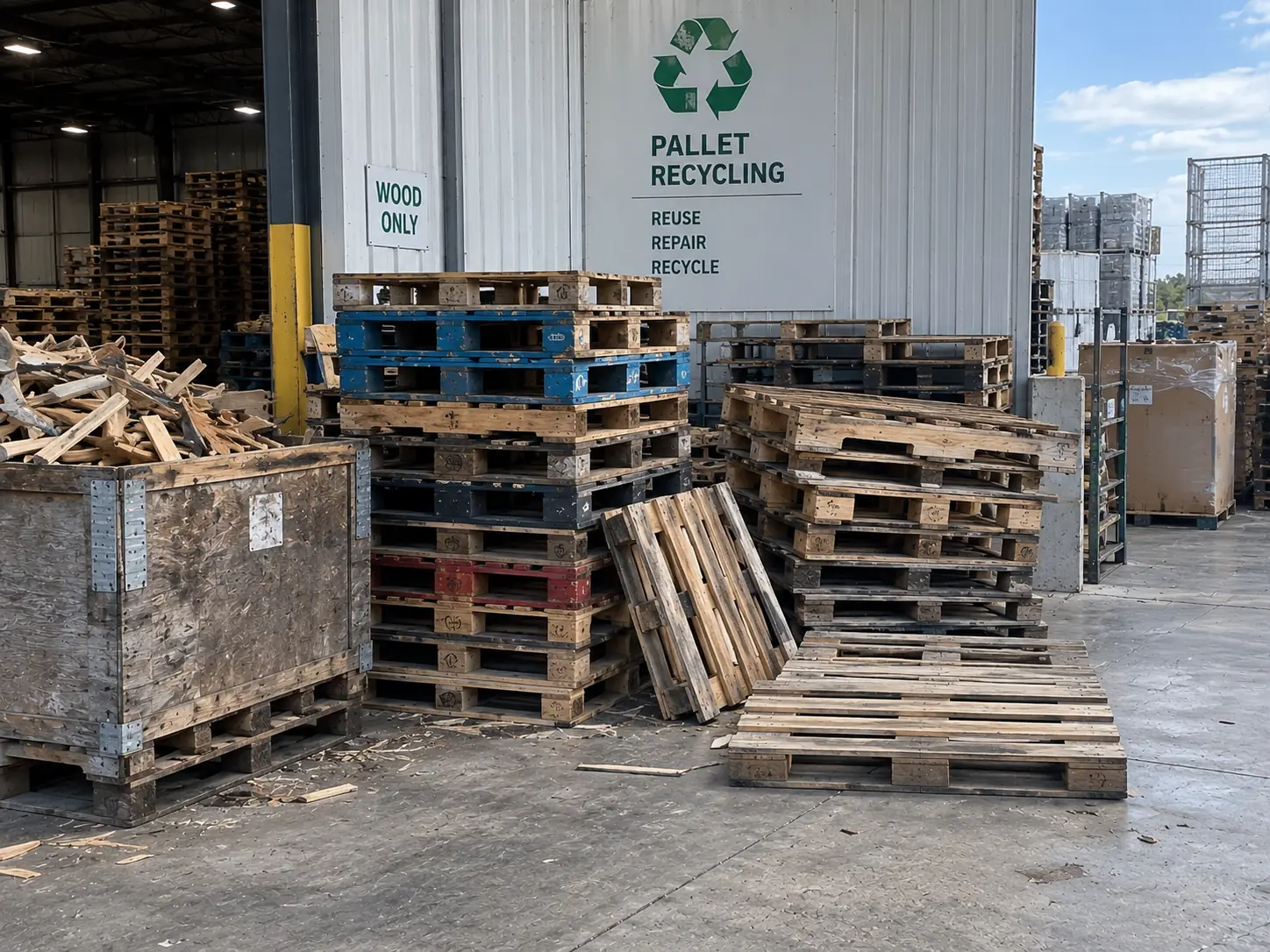
Across manufacturing plants, retail distribution centers, and wholesale operations, used pallets accumulate faster than most facilities plan for. A shipment arrives, goods are unloaded, and a stack of wooden pallets sits near the dock with no clear next step. Multiply that across daily receiving operations, and the volume becomes a real facilities management issue — one that affects floor space, safety compliance, waste costs, and vendor relationships simultaneously.
What makes this harder is that pallet disposal is rarely treated as a formal process. It tends to fall between departments — sometimes operations, sometimes procurement, sometimes facilities — and that ambiguity leads to inconsistent handling, missed recovery value, and unnecessary disposal costs. For companies shipping and receiving at scale, that informality has measurable consequences.
This guide addresses how wood pallet recycling actually functions across different business environments, what decisions drive good outcomes, and how US manufacturers, retailers, and distributors can build a more deliberate approach to pallet recovery and reuse.
Table of Contents
What Wood Pallet Recycling Actually Involves
Wood pallet recycling is not a single action — it is a system of collection, inspection, sorting, repair, and redistribution that moves used pallets back into productive use rather than sending them to landfill or letting them deteriorate on a loading dock. A thorough overview of wood pallet recycling makes clear that the process involves multiple decision points, and the value recovered depends heavily on how those decisions are managed upstream, at the point of collection.
Most pallets entering a recycling stream fall into one of three categories: those that can be reused as-is, those that need repair before reuse, and those that are too damaged to repair and must be broken down for raw material recovery. The proportion in each category depends on the type of pallets being used, how they are handled during shipping and receiving, and how quickly they are recovered after use.
The Repair and Grading Process
When pallets arrive at a recycling or reconditioner facility, they go through a grading process that determines their next path. Boards are checked for splits, breaks, and rot. Structural components are assessed for load-bearing integrity. Pallets that pass inspection either move directly into resale inventory or go to repair stations where broken components are replaced with salvaged lumber from pallets that could not be fully reconditioned.
This grading step is where the economics of pallet recovery are decided. A facility that receives pallets in good condition — sorted, stacked properly, and collected promptly — generates significantly more reusable inventory than one receiving broken, weather-exposed, or contaminated pallets. For the business generating those pallets, how they store and stage used units before pickup directly affects the value they can recover, whether through credit, reduced pickup fees, or exchange programs.
Raw Material Recovery When Reuse Is Not Possible
Pallets that cannot be repaired are broken down into raw wood material. This material typically enters one of several secondary markets: wood chips for biomass energy, mulch for landscaping, animal bedding, or particleboard manufacturing. These end markets exist and function reliably, but they return lower value than reconditioned pallets. A well-run recycling program minimizes the percentage of pallets reaching this stage by collecting units earlier and handling them more carefully in storage.
How Manufacturers Interact with Pallet Recovery Systems
Manufacturing facilities tend to generate high volumes of used pallets from inbound raw material shipments, and many also have outbound pallet needs for finished goods distribution. This dual role — receiving pallets and needing them — puts manufacturers in a position where pallet exchange programs can make operational and financial sense. Rather than accumulating used pallets and arranging separate pickup, manufacturers can participate in programs that credit returned pallets against the cost of new or reconditioned units supplied for outbound use.
The challenge in manufacturing environments is often space. Pallets pile up near receiving docks faster than they can be moved, creating safety concerns and compliance issues. Having a defined pickup schedule and designated staging areas keeps the dock clear and ensures that used pallets remain in recoverable condition. Exposure to rain, forklifts, and heavy traffic damages pallets quickly, and that damage reduces recovery value.
Pallet Pooling as an Alternative Model
Some manufacturers work within pallet pooling systems, where a third-party provider owns the pallets, tracks them through the supply chain, and manages retrieval and redistribution. This removes the asset management burden from the manufacturer but introduces dependency on the provider’s network and availability. Pooled programs work well in closed-loop supply chains where pallets move between a limited number of facilities. They are less suited to operations with many diverse shipping destinations where pallet return logistics become unpredictable.
Retail and Distribution Center Considerations
Retailers and distribution centers receive goods on pallets continuously and rarely ship outbound on the same pallets, which means used pallets accumulate on the receiving side with no natural reintegration point. This creates a straightforward disposal need but also a recovery opportunity that is often undermanaged. High-volume receiving facilities can generate substantial quantities of reusable pallets that have real resale value — if they are handled and stored properly before pickup.
One of the most common inefficiencies in retail environments is the lack of separation between pallet types. Mixed loads of standard and non-standard pallets, heat-treated and non-heat-treated units, and broken pallets combined with reusable ones all reduce the value of what gets collected. Sorting at the point of use — rather than leaving it to the recycler — improves recovery rates and can reduce or eliminate pickup fees for high-volume locations.
Managing Pallet Volume During Seasonal Peaks
Retail distribution is not a flat operation. Seasonal surges around major holidays, product launches, and promotional periods generate pallet volumes that can overwhelm standard pickup schedules. Facilities that do not plan for this often find pallets stacked in areas that block traffic flow, create fire code violations, or result in damage from exposure. Coordinating with pallet recovery providers ahead of peak periods — adjusting pickup frequency or arranging temporary staging solutions — is a practical way to maintain compliance and recovery quality when volume spikes.
Environmental and Regulatory Context
Wood pallet recycling intersects with several regulatory and environmental frameworks that US businesses should be aware of, even if they are not directly compliance-driven in day-to-day operations. The EPA’s sustainable materials management framework classifies used wood pallets as a recoverable material rather than waste when they are directed toward reuse or recycling programs, which has implications for how facilities report their waste diversion rates and track sustainability metrics.
For businesses exporting goods, heat treatment certification for wooden pallets under ISPM 15 standards remains a compliance requirement in many destination markets. Pallets entering the recycling stream that carry this certification retain more value because they can be reused in international supply chains. Businesses that track and separate heat-treated pallets from general inventory can capture that value more effectively.
Waste Diversion Reporting and Sustainability Goals
Many large manufacturers and retailers operate under internal sustainability targets that include landfill diversion rates. Wood pallet recycling contributes meaningfully to those metrics because pallets are heavy, volumetric, and landfill-costly when not recovered. Documenting the volume of pallets diverted through recycling and reuse programs provides quantifiable data that supports environmental reporting — a growing expectation from both corporate stakeholders and supply chain partners.
Building a Reliable Pallet Recovery Process
The difference between a functional wood pallet recycling program and an ad hoc disposal arrangement comes down to process consistency. Facilities that treat pallet recovery as a defined operational task — with assigned responsibility, designated staging areas, a fixed pickup schedule, and basic sorting standards — recover more value, maintain cleaner docks, and reduce the total cost associated with pallet management.
This does not require a large investment in infrastructure. The basic elements are straightforward: a location where used pallets are stacked safely and consistently, a protocol for separating broken from intact units, and a regular pickup arrangement with a qualified recovery provider. What makes the difference is that these elements are formalized rather than left to individual judgment on a shift-by-shift basis.
Evaluating Recovery Providers
Not all pallet recovery providers operate the same way, and the quality of service varies significantly across regions. When evaluating a provider, the most relevant factors are pickup reliability, the transparency of their grading and pricing process, their capacity to handle volume fluctuations, and whether they offer any form of credit or exchange for recovered pallets. A provider that offers clear documentation of what they collected and what condition it was in allows facilities to track recovery rates and identify handling issues upstream.
Businesses with multiple locations benefit from working with providers that can operate consistently across sites, reducing the administrative complexity of managing separate local arrangements at each facility.
Closing Perspective
Wood pallet recycling is a practical and mature industry function that most US manufacturers, retailers, and distributors are underusing in one way or another. The pallets are already there, the recovery infrastructure exists across most major markets, and the value — financial, operational, and environmental — is accessible without significant capital expenditure.
What most facilities lack is not access to recycling programs but the internal process consistency to make those programs work well. Pallets that are stored carefully, sorted reasonably, and collected on a defined schedule return measurably more value than those managed as an afterthought. For operations that handle high pallet volumes, formalizing that process is one of the lower-effort improvements available with real, recurring impact on cost, space, and sustainability performance.
The path forward is not complicated. It starts with treating used pallets as a recoverable resource rather than a disposal problem — and building the basic operational habits that make recovery reliable rather than occasional.
