
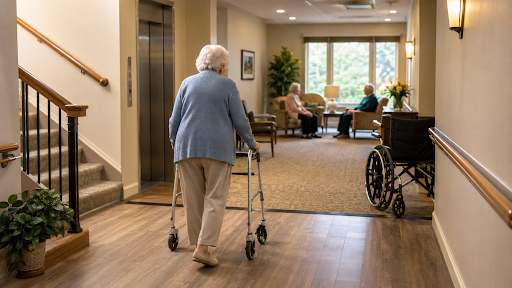
Responsible facility layout is structured to protect occupants.
In senior living facilities, there’s a greater likelihood of falls. In February 2026, the American Journal of Lifestyle Medicine published a study that showed falls in nursing homes are more likely than in other environments. Facilities reported that almost 23% of residents are victims of falls. Numbers were higher among females and residents with poor health, functional limitations, and chronic conditions.
The environmental and architectural flows in layouts increase the risk of falls.
Management and caregivers at assisted living facilities need to identify and minimize falls to ensure health, independence, and safety.
Table of Contents
Identifying Fall Risks
Knowing the risks that contribute to falls allows you to strategize and quickly readjust floor plans. Being proactive, you avoid liability issues and reputational harm.
Your safety net is to manage a multidisciplinary, continuous practice that combines environmental evaluations, clinical assessments, and ongoing observation. You implement solid screening frameworks that track indicators and influence effective strategies.
On the resident side, management and care teams must always be on the prowl for extrinsic and intrinsic factors.
- Meds: Polypharmacy or psychoactive scripts can impact coordination and alertness
- Cognitive issues: Staff must be aware of residents with dementia, impulsivity, and memory issues that can lead to accidents
- Decreased vision and sensation: Vision acuity, neuropathy, depth perception, etc., increase the likelihood of tripping, staggering, and falling.
- Ecosystem hazards: Clutter, poor lighting, torn carpets, and no grab bars; all contribute to falling
- Balance and mobility: Look at your clientele and ascertain weaknesses: history of falls, gait, Parkinson’s, glaucoma, dementia, etc.
Assessing Risks With the Right Tools
Senior communities use evidence-based tools grounded in nurse administration. They take the results to gauge an individual’s stability and what could contribute to a loss of balance and, subsequently, a fall.
Morse Fall Scale
As a healthcare tool for evaluating the likelihood of falls, the Morse Fall Scale looks at key variables: fall history, ambulatory aids, secondary diagnosis, heparin/IV lock, and mental status.
Berg Balance Scale
The Berg Balance exam asks a patient to conduct 14 tasks of increasing difficulty. Each item is scored from 0 to 4. High numbers represent good balance and mobility. The test requires a chair with armrests, one without armrests, a stopwatch, and tape or ruler.
Timed Up and Go Test
The TUG (Timed Up and Go) test is a short clinical assessment that measures an individual’s balance, mobility, and fall risk. The exam records how long it takes a person to stand up, sit down, and walk short distances. Measured in seconds, higher scores indicate poor mobility and a higher risk of falling.
Designing an Effective Layout
Most falls are not necessarily the result of the resident’s immobility but of factors in the layout. Teams must make appropriate changes to prevent accidents. A solid facility layout optimizes flow and arrangement, which reduces bottlenecks. That can include stepless entries, ADA-compliant bathrooms, roll-in showers, etc. Essential elements combine with floor plans to balance comfort and vibrancy with intuitive, safe navigation.
Key Characteristics
You want to avoid monotonous passageways. Facilities should use distinctive color palettes, unique artwork, and wall accents that help residents find their way. Where feasible, outdoor spaces and corridors should have circular paths, allowing stress-free wandering.
Safety measures can be strengthened by simplifying movement. Eliminate steps. Residencies should utilize elevators, ramps, or single-level designs. Poor vision can hurt depth perception. Proper contrast and lighting help reduce glare. Avoid deep patterns in flooring (matte would be best). Light switches should be high and visible. Install grab bars as needed. Last, transitions between areas should be flush.
Install raised toilets and floating sinks in bathrooms for wheelchair access. Integrate emergency response systems in baths and bedrooms, in addition to wearable pendants. If residents have access to kitchens or kitchenettes, have accessible fridge-and-microwave installations that promote autonomy while mitigating safety risks.
Keep in mind that the layout should adopt specialized, practical layouts while promoting a “household” model. Give communal and social spaces cues for comfort with appropriate institutional setups. Noisy equipment and medical carts should be accessible and out of sight. Foster socialization through strategic seating with open space for walkers, canes, and wheelchairs. These are practical steps that help residents navigate. Incorporate secure outdoor spaces and large windows that maximize natural light. The implementations help regular circadian rhythms. The bottom line is to produce a thoughtful balance of healthcare and safety, both functional and welcoming.
To dive deep into facility layouts, take a look at an extensive layout guide or read about the focus for resident-centered care.
Choosing the Right Facility Layout
Let’s cover how to pick floor plans that ensure greater support, care, and comfort.
Identify Lifestyle and Care Needs
It’s going to be a complex task, but you must imagine the best ways to accommodate mobility, health conditions, lifestyle choices, and social preferences, and how that can differ across your client base. For the most part, this means beginning prevention before a resident moves in. Each resident should be tested carefully. Direct-care teams should consult with family, doctors, and other caregivers to align safety with comfort in an optimized living space.
Rest, Sleep, and the Environment
Sleep, or lack thereof, impacts all of us. However, restless sleep is a risk with older persons, especially those with age-related cognitive conditions. Poor sleep increases confusion and agitation. You need to know how the person sleeps and how agile they are getting in and out of bed. Even bed placement is key. Flush against the wall provides a better pathway in and out of the room. Bed placement plays a part in fast transfers when needed.
Peace and Familiarity
A peaceful and calm environment promotes serenity. Clean, open spaces are positive; clutter is visual noise and influences anxiety. In layouts, designate spaces that provide visual comfort. Assign spaces for keys and other important accessories. Use labels to encourage familiarity. Personal photographs will help residents familiarize themselves with the surroundings.
Conclusion
You probably can’t eliminate falls. However, implementing the right protocols lowers their possibility. Deploying the right tools and making the most of your layout definitely improves reputation and liability risk.
But, as we said, falls cannot be eliminated. That’s when you need a knowledgeable personal injury attorney who has experience with nursing home abuse claims.

