
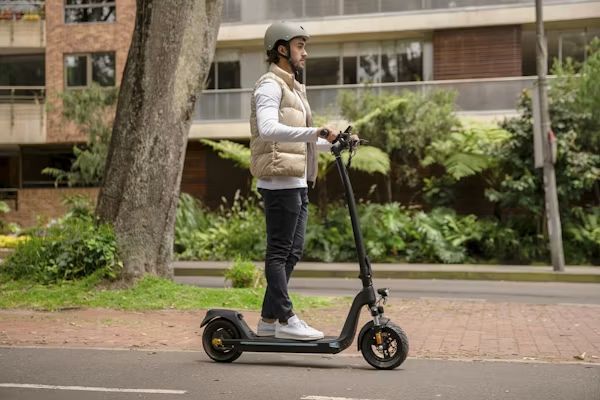
There was a time when ‘electric scooter’ meant either a toy for kids or a rental scattered on a city sidewalk that you tried not to trip over. Both of those still exist, but they share a category with something very different: serious adult electric scooters built for real commuting, capable of 60 to 100 km/h, with batteries that go 100 km on a charge and motors that climb hills like they aren’t even there. These are not toys. They are legitimate alternatives to a car for a lot of trips.
If you are an adult looking at this category, the buying experience is genuinely confusing. The range of options runs from $400 portable models for short urban hops to $5,000+ machines that out-perform 125cc motorcycles in stop-and-go traffic. Knowing which end of the spectrum you actually need is the first real decision.
Looking through electric scooters Canada collections from established retailers will give you a sense of the full range, from compact daily commuters to high-performance models built for serious distance and speed. The category has matured significantly in recent years. A modern adult-targeted scooter is a much more sophisticated machine than what was on the market even three or four years ago, and the buying decision deserves that level of attention.
Table of Contents
The category has grown up fast
Electric micromobility has become a real piece of the Canadian transportation picture. The Canadian e-bike market alone is projected to grow at an 11.4 percent compound annual growth rate from 2025 to 2030, reaching USD $2.14 billion, according to Grand View Research. The electric scooter segment is tracking along similar lines as adults discover that a high-performance scooter is a credible everyday transportation tool, not just a novelty.
Be honest about how you’ll actually use it
The number one mistake first-time buyers make is buying for a fantasy use case rather than their actual day. The person who imagines weekend mountain rides ends up commuting 6 km to a coffee shop on a 35 kg off-road monster. The person who needs to ride 20 km each way to work ends up with a 12 kg folding scooter that runs out of battery halfway home.
Before looking at specs, work out:
- How long is your typical ride? Short trips (under 5 km) are very different from medium commutes (5 to 15 km) and serious distance (over 20 km each way).
- Where are you riding? Smooth city streets, rough urban roads with potholes, dedicated bike lanes, mixed-use paths, or off-road terrain?
- How much do you need to climb? Flat terrain is very forgiving. Significant hills demand more motor power and battery capacity.
- How much does portability matter? Carrying it up stairs, fitting in a car trunk, bringing it on transit. These matter for some people and not at all for others.
- Solo or two-up? Some adult scooters are rated for a passenger. Most are not.
Match the scooter to the actual life. The right specs flow from there.
Range is the trickiest spec on the page
Manufacturers publish a range number. Treat it as a maximum under ideal conditions, not a realistic expectation. A scooter rated for 60 km might give you 35 to 45 km in real-world riding, less in cold weather, less if you are heavier, less if you are climbing, less if you are pushing maximum speed.
Practical rule: plan around 60 to 75 percent of the advertised range for everyday riding. If you need 30 km of round-trip commuting, look at scooters with at least 45 to 50 km of advertised range. Buying more battery than you strictly need is almost always smarter than buying less.
Motor power separates the categories
Motor power is what determines how the scooter actually feels. A few useful brackets:
- Sub-500W: Light, basic urban scooters. Fine for flat terrain and short distances. Struggles on hills and with larger riders.
- 500W to 1000W: Solid commuter range. Handles moderate hills, comfortable for most adults, decent acceleration.
- 1000W to 2000W: Strong performance category. Climbs steep hills, accelerates quickly, comfortable at higher speeds.
- 2000W and up (often dual motor): Serious performance. These are the machines that hit 80 to 100 km/h and require respect on the road.
Higher motor power costs more, weighs more, and uses battery faster. Match power to what you actually need, not what sounds impressive.
Build quality matters more than top speed
A cheap high-performance scooter will spend more time in repair than on the road. Components that genuinely matter for build quality:
Frame construction. Solid aluminum frames with proper welds last. Folding mechanisms are common stress points and the cheap ones develop slop quickly.
Suspension. Front suspension at minimum, full suspension for rough terrain. Cheap dual suspension is often worse than no suspension.
Brakes. Hydraulic disc brakes are dramatically better than mechanical disc brakes, which are dramatically better than drum brakes. For anything above 30 km/h, hydraulic discs are not optional.
Tires. Tubed tires are cheap but get flats. Tubeless or solid tires cost more but are more reliable. Tire size and tread also affect ride quality significantly.
Battery. UL-certified batteries from named cells (Samsung, LG, Panasonic) cost more but are dramatically safer and last longer than generic alternatives.
The legal situation varies by province
Canadian rules for electric scooters are inconsistent. Some provinces have specific pilot programs allowing certain scooter models on certain roads. Others have not legalized them at all for public use. Many cities have their own rules layered on top.
Before buying, check what is actually legal where you live and where you plan to ride. A perfectly legal scooter in Vancouver may not be legal in Toronto. A scooter you can ride on bike paths in one city may not be permitted in another.
Don’t forget the gear
At higher speeds, an electric scooter is real transportation and deserves real safety gear. At minimum: a proper helmet, gloves, eye protection, and visible clothing. For commuter use, lighting and reflectors are essential. For higher-performance scooters that reach motorcycle speeds, more comprehensive gear is appropriate.
Buying from a real dealer is worth the small premium
Online-only direct-from-overseas scooters look like deals on paper. They are often a mess once you need service, parts, warranty support, or even a charger that fits the local outlet. Local dealers cost slightly more upfront and save you significant pain when something needs attention. Most established Canadian scooter dealers have service departments, parts inventories, and real warranty support. Use them.

