

In today’s hyper-competitive digital world, just being online is not enough. For real growth, we need a clear plan. This plan guides our efforts. It also helps us get the best return for our money.
But many businesses do not have a clear strategy. A Smart Insights report shows that only 17% do.
A digital marketing strategy is a big, long-term plan. We design it to reach our business goals. We do this using online tools. It is the key link between our business aims and our marketing actions. It makes sure every step is on purpose and measurable. It aligns with our main vision for growth.
Using a data-driven approach changes this plan. It moves it from a fixed document to a smart system. This system changes with the market. It helps us get predictable results.

Table of Contents
The Foundation: Strategy vs. Tactics and Core Components
A common point of confusion in marketing is the distinction between strategy, campaigns, and tactics. Understanding this hierarchy is fundamental to building an effective plan. A solid strategy provides the “why” behind our actions, giving purpose and direction to all our marketing efforts. Without it, even the most creative tactics can fall flat, leading to wasted resources and missed opportunities.
Strategy, Campaigns, and Tactics: Understanding the Hierarchy
Think of your strategy as the master blueprint for building a house. It outlines the ultimate goal (a finished, functional home) and the overall approach. Campaigns are the major phases of construction, like laying the foundation or framing the walls—they are coordinated efforts with a specific objective and timeline. Tactics are the individual tasks, such as hammering a nail or installing a window. A strategy provides the overarching vision, campaigns organize actions around a specific goal (e.g., “Increase Q3 lead generation”), and tactics are the concrete actions within that campaign (e.g., running a specific Google Ad or publishing a blog post). When aligned, they create a powerful, cohesive force that drives momentum toward our goals.
A digital marketing strategy is a long-term, high-level plan that defines objectives, identifies target audiences, and provides a framework for all marketing activities across digital channels. It’s the guiding policy for dealing with the challenge of achieving our business objectives in the online field. In contrast, a digital marketing campaign is a time-bound initiative designed to achieve specific goals within the broader strategy. For example, a campaign might focus on promoting a new product launch over a specific month. Digital marketing tactics are the granular, actionable steps executed within a campaign. These could include creating a social media post, optimizing a webpage for a specific keyword, or sending an email newsletter. The critical difference lies in scope and duration: strategy is the overarching, long-term plan; campaigns are focused, time-limited projects; and tactics are the daily actions that bring campaigns to life. This layered approach ensures every marketing effort works cohesively toward shared business objectives, preventing disjointed efforts and maximizing impact.
The Core Components of a Winning Digital Marketing Strategy
A robust digital marketing strategy is built on several key pillars that work together to create a comprehensive framework for success. These components ensure that our efforts are not only purposeful but also measurable and adaptable.
- Clear Business Objectives: We begin by defining what we want to achieve using the SMART (Specific, Measurable, Achievable, Relevant, Time-bound) framework. These objectives should be directly aligned with our broader business goals, whether it’s increasing market share, boosting brand engagement, or improving customer retention. For instance, instead of a vague goal like “increase website traffic,” a SMART objective would be “Increase qualified website traffic from organic search by 20% within the next six months.”
- Deep Audience Understanding: We cannot effectively market to an audience we don’t understand. This component involves developing detailed buyer personas based on real market research and data from our existing customer base. We go beyond basic demographics to uncover our ideal customers’ goals, challenges, motivations, and where they spend their time online. This deep understanding allows us to tailor our messaging, content, and channel selection to resonate powerfully with the people we want to reach, making our marketing efforts significantly more effective. Buyer personas play a pivotal role in shaping our entire digital marketing strategy, ensuring every message is crafted for the right recipient.
- Competitive Analysis: We identify our direct and indirect competitors, analyze their digital marketing strategies, strengths, and weaknesses, and look for gaps in the market we can capitalize on. This isn’t about imitation but about identifying opportunities for differentiation and understanding what’s working (or not working) in our industry. By learning from competitors, we can refine our own value proposition and position ourselves uniquely.
- Channel & Asset Plan: We evaluate our existing digital assets and potential channels using the owned, earned, and paid media framework.
- Owned Media refers to the digital properties our brand or company controls entirely, such as our website, blog, and social media profiles. We have complete control over the content and messaging here.
- Earned Media is anything published about our business by a third party for which we haven’t paid, like customer reviews, press mentions, or social media shares. It builds credibility and trust.
- Paid Media includes any channel we spend money on for visibility, such as Google Ads, social media advertising, or display ads. We assess which channels are most effective for reaching our audience and supporting our objectives.
- Key Performance Indicators (KPIs): We select the right metrics to measure progress against our goals and prove the return on investment (ROI) of our efforts. KPIs move beyond vanity metrics to focus on tangible results that directly impact our business objectives. For example, if our goal is lead generation, KPIs might include conversion rate, cost per lead, and lead-to-customer ratio. Clear KPIs are essential for understanding what’s working, what’s not, and where adjustments are needed.
Building Your Data-Driven Digital Marketing Strategy: A Step-by-Step Guide

Creating a strategy from scratch can seem daunting, but breaking it down into a logical, step-by-step process makes it manageable and effective. This structured approach ensures that our plan is grounded in data and aligned with our business’s unique context from the very beginning. Each step builds upon the last, creating a comprehensive and actionable roadmap for growth.
Step 1: Define SMART Goals and Establish KPIs
Our goals are the destination on our strategic map. Instead of vague aspirations like “increase sales,” we use the SMART framework to set clear targets, such as “Increase qualified marketing leads by 25% in the next six months.” This ensures our goals are Specific, Measurable, Achievable, Relevant, and Time-bound. Once goals are set, we identify the Key Performance Indicators (KPIs) that will track our progress. For a lead generation goal, relevant KPIs would include Cost Per Lead (CPL), Conversion Rate, and website traffic from lead forms. This ensures that every activity can be measured against a concrete outcome, allowing for continuous optimization. Studies show that clear goals help teams do better; a 2022 OKR impact report found that 98% of companies had better visibility into performance after using clear goal systems. This clarity is particularly important when managing digital marketing across various channels and teams.
Step 2: Develop In-Depth Buyer Personas
We cannot effectively market to an audience we don’t understand. Buyer personas are semi-fictional representations of our ideal customers based on market research and real data from our existing customer base. We go beyond basic demographics (like age, location, and income) to uncover their goals, challenges, motivations, and where they spend their time online. What issues do they face? What are their interests? Where do they seek information? Tools like web analytics can help identify geographic locations of website traffic, and persona research interviews can provide sensitive information like income and motivations. HubSpot offers templates to help organize audience segments and strengthen marketing with clear visualizations of target audiences. This deep understanding allows us to tailor our messaging, content, and channel selection to resonate powerfully with the people we want to reach, making our marketing efforts significantly more effective and ensuring our strategy is customer-centric.
Step 3: Audit Your Digital Ecosystem (Owned, Earned, & Paid)
Before planning for the future, we must understand our current position. We conduct a thorough audit of our digital assets across three categories:
- Owned Media: This includes our website, blog, social media profiles, and any other digital properties we fully control. We analyze content performance (e.g., popular blog posts, engagement on social media), SEO rankings, and user experience on our website. We look at what content drives traffic, generates leads, or encourages engagement. For example, we might find that a particular article on our blog consistently drives high-quality traffic.
- Earned Media: This encompasses third-party mentions, customer reviews, press coverage, and social media shares. We evaluate referral traffic from these sources and analyze brand sentiment. Tools like HubSpot’s Sources reports can help identify which external mentions or platforms are driving qualified traffic to our website.
- Paid Media: This includes our Pay-Per-Click (PPC) campaigns, social media ads, display advertising, and other paid channels. We assess the ROI, Cost Per Click (CPC), and conversion rates of these campaigns. We use tools like Google Ads PPC kits to learn how to leverage paid advertising effectively. This audit helps us determine which paid platforms are delivering results and which might need adjustment or removal.
A comprehensive audit reveals what’s working, what’s not, and where the biggest opportunities lie, forming the foundation for a predictable digital marketing strategy. This step is crucial for making informed decisions about resource allocation and future campaign development.
Key Channels and Tactics for Execution
With a solid strategy in place, the next step is to choose the right channels and tactics to bring it to life. The most effective approach often involves an integrated mix of channels, each playing a distinct role in engaging our audience at different stages of their journey. The key is to select tactics that align with our goals and resonate with our buyer personas.
Content Marketing and SEO: The Engine of Organic Growth
Content marketing and Search Engine Optimization (SEO) are inextricably linked. Content marketing is the practice of creating and distributing valuable, relevant, and consistent content to attract and engage a clearly defined audience. SEO is the process of optimizing that content so it can be found by search engines. According to HubSpot, B2B brands report that their website, blog, and SEO were the top marketing channels for ROI in 2024. This highlights their foundational importance.
Content is the backbone of our digital presence. Whether it’s blog posts, e-books, infographics, videos, or podcasts, content helps convert website visitors into leads and customers while improving our search engine rankings. Buyers view around three to five pieces of content before engaging with a sales representative, underscoring the need for a robust content strategy. Consumers also read between one and four blog posts per month, making blogging a vital channel for providing value and establishing authority. We focus on creating high-quality, informative content that answers our audience’s questions and optimizes it for relevant keywords using tools like Google Keyword Planner. This builds a sustainable engine for attracting organic traffic and establishing our brand as a trusted authority. The Content Marketing Institute noted that 71% of B2B marketers in 2023 said content marketing has become more important to their organization, reflecting a shift towards building trust and credibility.
Paid Advertising: Accelerating Reach and Results
While organic growth from content and SEO is a long-term goal, paid advertising offers a powerful way to accelerate results, test new markets, and target specific audience segments with precision. Channels like Google Ads, social media ads (e.g., Facebook, Instagram, LinkedIn), and display advertising allow us to place our message directly in front of potential customers who are actively searching for solutions or fit a specific demographic profile. The biggest benefit of paid advertising is its immediacy; we can choose a platform, set a budget, create compelling copy and visuals, and launch campaigns quickly. This flexibility makes it an excellent option for growing businesses looking for rapid visibility and lead generation. The key to success with paid media is continuous testing and optimization—from ad copy and creative to landing pages and audience targeting—to ensure we are maximizing our return on ad spend (ROAS). HubSpot offers an Advertising Plan Template to help streamline this process.
Social Media and Influencer Marketing: Building Community and Trust

Social media is no longer just a broadcast channel; it’s a platform for building communities, fostering engagement, and creating authentic connections. We choose the platforms where our buyer personas are most active and focus on providing value rather than just promoting products. With billions of active social media users globally, these platforms offer immense reach and opportunities for direct interaction. More and more marketing teams are exploring using social media DMs for customer service, indicating a shift towards direct, personalized communication.
Influencer marketing, when done correctly, can amplify our social media efforts. The global market for influencer marketing has quadrupled since 2019, with a growing trend toward partnering with niche micro-influencers who have smaller but highly engaged and trusting audiences. These influencers often offer more cost-effective partnerships and can foster stronger community bonds, leading to more authentic content and higher conversion rates. HubSpot provides an Ultimate Guide to Influencer Marketing to help steer this growing channel. By integrating social media and influencer strategies, we can build brand awareness, drive engagement, and leverage trusted voices to connect with our target audience.
Measurement, Adaptation, and Future-Proofing Your Strategy
A digital marketing strategy is not a “set it and forget it” document. The digital world is in a constant state of flux, and our strategy must be agile enough to adapt. This requires a commitment to ongoing measurement, a willingness to experiment, and an eye toward future trends that will shape the landscape.
Measuring Success: From Data to Actionable Insights
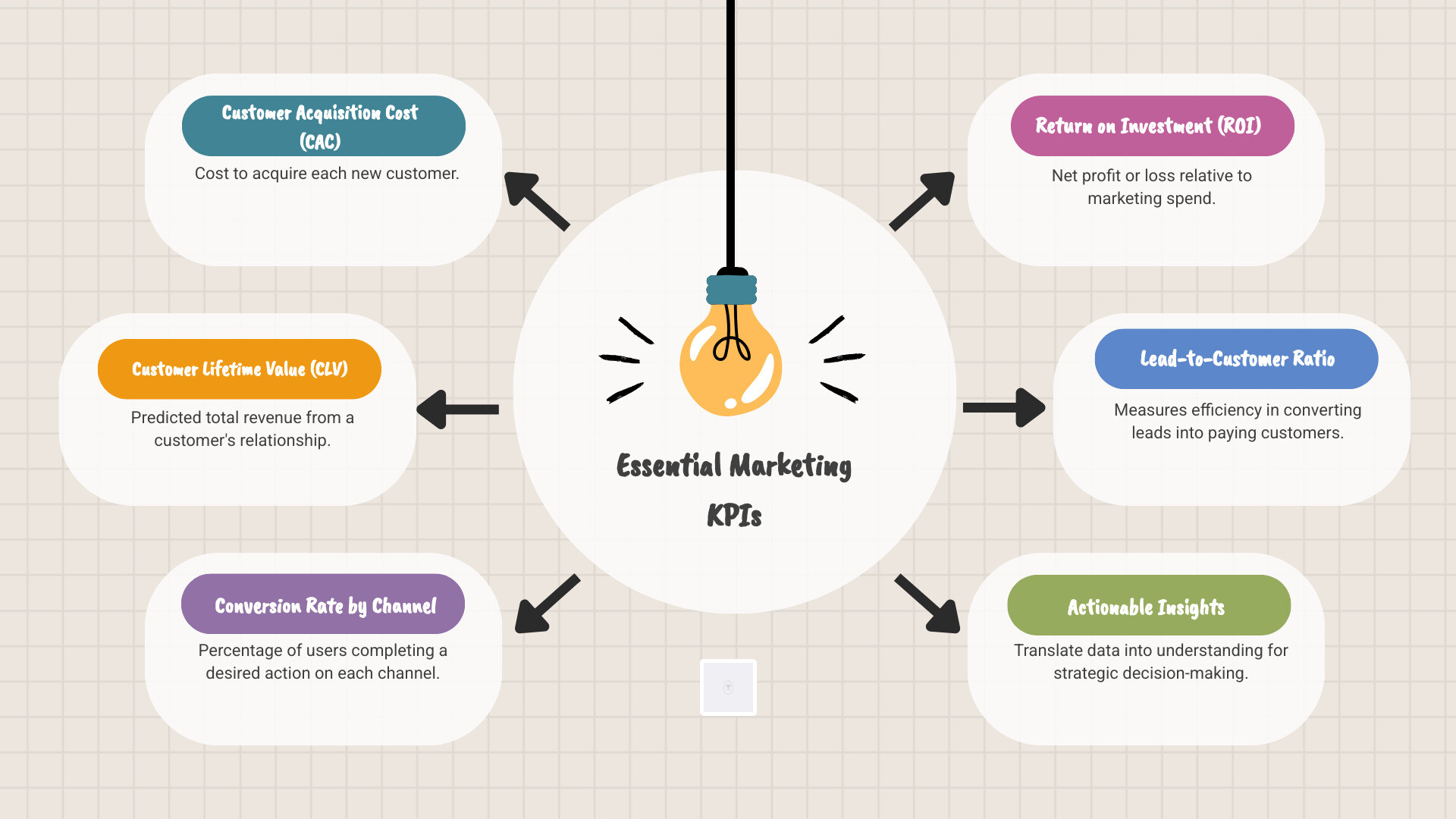
The “data-driven” component of our strategy comes to life in the measurement phase. Using tools like Google Analytics, CRM platforms, and native social media analytics, we can track our KPIs in real-time. However, data is only useful when it’s translated into insight. The goal is to move beyond simply reporting numbers to understanding the story they tell about our customers and our marketing effectiveness. Essential marketing KPIs include:
- Customer Acquisition Cost (CAC)
- Customer Lifetime Value (CLV)
- Conversion Rate by Channel
- Return on Investment (ROI)
- Lead-to-Customer Ratio
- Organic Traffic
- Social Media Engagement Rate
HubSpot’s Marketing Analytics & Dashboard Software, for instance, makes it easy to track marketing efforts and customize dashboards to ensure we’re monitoring the most relevant metrics. We use these insights to identify what works, what doesn’t, and where to adjust our strategy. Changing raw data into a coherent narrative that informs decisions is the core of a data-driven digital marketing strategy. This continuous feedback loop is what allows us to refine our approach and optimize for better results.
Adapting to Evolving Trends: AI, Visual Storytelling, and Privacy
To stay competitive, we must anticipate and adapt to emerging trends. Artificial Intelligence (AI) is already revolutionizing marketing through personalization, predictive analytics, and automated tools. AI chatbots were named the top channel that brands are planning to use for the first time in 2025, indicating a significant shift in customer service and engagement. AI tools can also assist with content generation and email drafting, enhancing efficiency. An AI Search Grader can help us gauge our brand’s visibility across AI-powered search engines, allowing us to control the information chatbots pull from our website.
The rise of visual storytelling, particularly short-form video, reflects changing content consumption habits. Platforms like TikTok and Instagram Reels are increasingly popular, with marketers planning to increase investments in these channels. Video content is not only highly engaging but also easier to remember than text and highly shareable.
Furthermore, increasing privacy regulations and the move toward a cookie-less internet underscore the growing importance of building direct relationships with customers and leveraging first-party data. This means focusing on opt-in email marketing and content that builds trust and encourages direct engagement, rather than relying solely on third-party tracking.
Common Pitfalls to Avoid in Your Digital Marketing Strategy
Even the most well-intentioned strategies can fail if we fall into common traps. Being aware of these pitfalls helps us steer clear of them:
- Setting Vague Goals: Without clear, measurable objectives, we have no way to gauge success. This leads to wasted effort and an inability to demonstrate ROI. Our goals must be SMART.
- Ignoring Your Audience: Creating content and campaigns without a deep understanding of our buyer personas means our messages will likely miss the mark. We must consistently refer back to our audience research.
- Inconsistent Messaging: A disjointed brand voice or conflicting messages across different channels can confuse customers and erode trust. Consistency builds brand recognition and loyalty.
- Failing to Measure and Adapt: Neglecting to track our KPIs and make data-informed adjustments is akin to driving blind. The digital landscape changes rapidly, and our strategy must evolve with it.
- Chasing “Shiny Objects”: Jumping on every new trend or platform without first considering if it aligns with our strategy, audience, and resources is a common mistake. Not every trend is right for every business; we must be selective and strategic.
Conclusion
Driving business growth in the digital age requires more than just a collection of marketing tactics; it demands a cohesive, data-driven digital marketing strategy. By setting clear goals, deeply understanding our audience, choosing the right channels, and committing to a cycle of execution, measurement, and adaptation, we can build a powerful and predictable engine for sustainable growth. Our strategy is the roadmap, and data is the compass that keeps us on course, empowering us to steer the complexities of the digital world and connect with our customers in meaningful, profitable ways.

