
Academic publishing is built on a fragile foundation of trust. When you read a paper, you assume the references are real. When you review a manuscript, you assume the citations point to actual sources. When you submit your own work, you assume your reference list is accurate. But these assumptions are becoming increasingly dangerous. In 2023 alone, over 14,000 retraction notices were issued — the highest annual total on record — and a growing proportion of these retractions trace back to citation errors. Not data fabrication. Not image manipulation. Just bad references. The problem has become so systemic that beginning with the 2025 Journal Citation Reports, citations to and from retracted articles will be excluded from the Journal Impact Factor numerator. The message from the publishing industry is clear: citation integrity is no longer optional. It is a metric of quality. And that is why a free tool called AI Citation Checker has quietly become an essential part of the academic workflow for over 30,000 scholars across 200+ universities.
Table of Contents
The New Reality: AI-Generated References Are Everywhere
The rise of large language models has transformed how students and researchers approach literature reviews. These tools are remarkably good at producing text that sounds authoritative. They are also remarkably good at producing citations that look real but lead nowhere. A student using ChatGPT to draft a literature review may receive a reference list with perfectly formatted entries — complete with author names, journal titles, volumes, pages, and DOIs. Every element looks legitimate. But when you actually search for those papers, they do not exist. The AI hallucinated them.
This is not a theoretical concern. It is happening right now, in real submissions, across every discipline. And the consequences are severe. A paper submitted with fabricated citations is not just sloppy — it is a retraction waiting to happen. The author may have had no intent to deceive, but intent does not matter to a journal editor. What matters is the record. And the record shows a citation that does not exist.
How CiteTrue Addresses the Trust Gap
CiteTrue positions itself as a verification layer that sits between the author and the submission process. It does not write your paper. It does not generate your references. It does one thing: it checks whether the citations you have listed actually exist in the academic record.
The Verification Flow
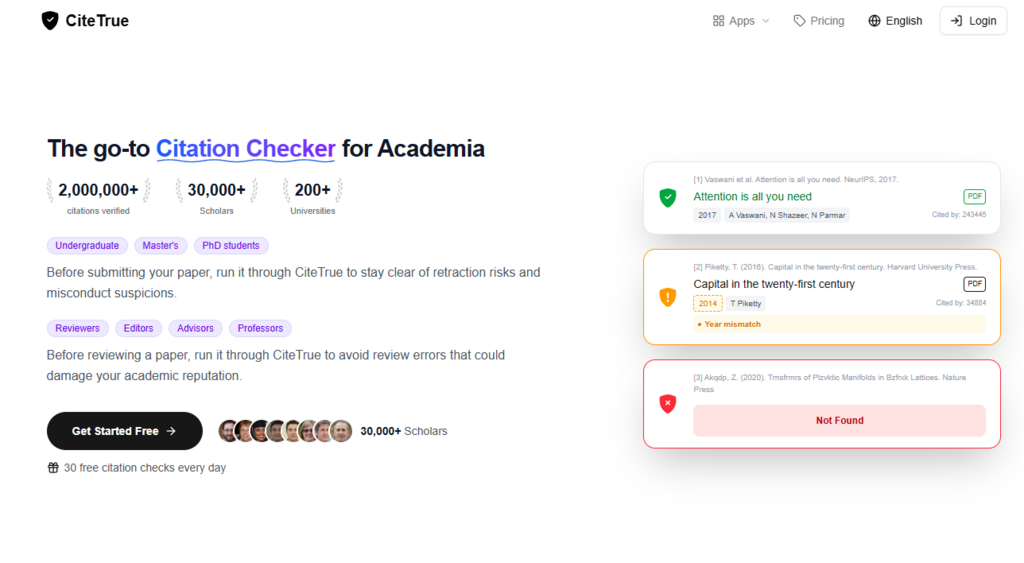
Input and processing. You paste your reference list into a text box on the homepage. The tool accepts citations in various formats and automatically corrects minor formatting errors. Once submitted, the system splits the list into individual citations and queues them for processing against multiple authoritative academic databases.
Cross-referencing and scoring. The tool uses retrieval algorithms combined with AI models to cross-reference author names, publication years, journal titles, and DOIs against millions of academic papers, journals, and books. Each citation receives a confidence score based on a proprietary verification model. A high score means the citation checks out. A low score means something is off — a missing author, a mismatched year, or an entry that simply cannot be found.
Results and action. The output is a clean list with each citation accompanied by its confidence score and any flags. Users can quickly identify which references need manual follow-up and which are solid. The entire process takes seconds.
The Stakeholders: Who Benefits and How
The tool’s value varies depending on your role in the academic ecosystem. Here is how different stakeholders actually use it:
For Students: The Pre-Submission Safety Net
Undergraduates and graduate students face a unique challenge. They are often new to academic writing, unfamiliar with citation standards, and reliant on online sources that may not be reliable. Monique A. White, an undergraduate psychology student quoted on the site, describes the anxiety of writing course papers with sources found online. She says she constantly worried about incorrect formatting and unreliable sources. CiteTrue, she notes, verifies each citation in seconds and flags suspicious sources. She now runs every paper through the tool before submission.
For doctoral students, the scale is even more daunting. Peteul K., a PhD candidate in computer science, points out that a dissertation can easily contain hundreds of references. Manual verification is not realistic. He also highlights a growing concern: many literature reviews now contain AI-generated content. CiteTrue caught several non-existent fake citations in one batch, saving him from potential embarrassment or retraction.

For Professors: The Quality Control Layer
Robert Genzel, a professor of electronic engineering, uses the tool to check student submissions. He can identify questionable or fabricated citations in minutes. In an era of AI-assisted writing, he views this kind of verification as essential for maintaining academic rigor. The tool does not replace his judgment — it augments it. It allows him to focus his attention on the papers that need it most, rather than spending hours manually checking references.
For Editors and Reviewers: The Initial Screening Tool
Elizabeth Hayes, a journal editor in cardiology, deals with a high volume of submissions. Citation fraud is one of the hardest problems to detect manually. CiteTrue allows her to screen manuscripts at the initial review stage, filtering out papers with unreliable references and focusing on quality work. The tool has become a standard part of her editorial workflow.
Where CiteTrue Fits in the Verification Landscape
| Aspect | Traditional Manual Checking | CiteTrue |
| Time per 100 citations | 60–90 minutes | Seconds |
| Formatting flexibility | Requires strict adherence to style | Automatically corrects minor errors |
| Database coverage | Limited to what you personally can access | Cross-references multiple authoritative databases |
| Scalability | Poor — fatigue leads to missed errors | Excellent — handles batches of any size |
| Learning curve | None — but tedious | Minimal — paste and go |
| Cost | Your time | Free |
The Realistic Limitations You Should Know
No tool is perfect, and CiteTrue does not claim to be. Here are the boundaries based on the information available on the site and practical usage:
Database coverage has limits. The tool cross-references “leading academic databases,” but no database is exhaustive. Obscure journals, very recent publications, or non-English sources may not appear in the index. In practical use, mainstream citations verify reliably, but niche references may require manual follow-up.
Confidence scores are estimates. A high score indicates that the citation exists and its metadata matches. It does not mean the cited paper actually supports the claim you are making. That requires human judgment. The tool verifies existence and accuracy of metadata, not argumentative validity.
Results may vary. The verification process depends on the quality of the input. Severely malformed citations — missing authors or garbled titles — may not verify correctly. The tool can only work with the data it receives.
The tool is a supplement, not a replacement. It catches errors that would otherwise slip through. It does not replace careful reading or critical thinking.
A Practical Workflow for Researchers
From a practical user perspective, the most effective way to use CiteTrue is as a pre-submission safety check. Here is a workflow that makes sense:
- Write your paper and compile your reference list as you normally would.
- Before submitting, paste your entire bibliography into the tool.
- Review the results. Pay special attention to citations with low confidence scores.
- Investigate any flagged entries manually. If a citation is marked as suspicious, verify it against the original source.
- Make corrections and run the verification again if you have made substantial changes.
This process adds minimal time to your workflow — seconds for the verification itself, plus a few minutes for manual follow-up — while catching errors that could otherwise lead to retraction.

Why This Matters Now
The academic publishing landscape is shifting. Journals are becoming more rigorous about citation integrity. AI tools are making it easier to generate fake references. And the pressure on researchers to publish is not going away. In this environment, a free, fast, and reliable verification tool is not a luxury. It is a basic necessity.
CiteTrue does not solve every problem. It does not check whether your arguments are sound or whether your methodology is robust. But it does solve a specific, important problem: it tells you whether the papers you are citing actually exist. That is a foundation upon which everything else depends.
If you are preparing a paper, thesis, or review, give Citation Checker a try before you hit submit. The few seconds it takes could save you from a much longer conversation with a journal editor.

