
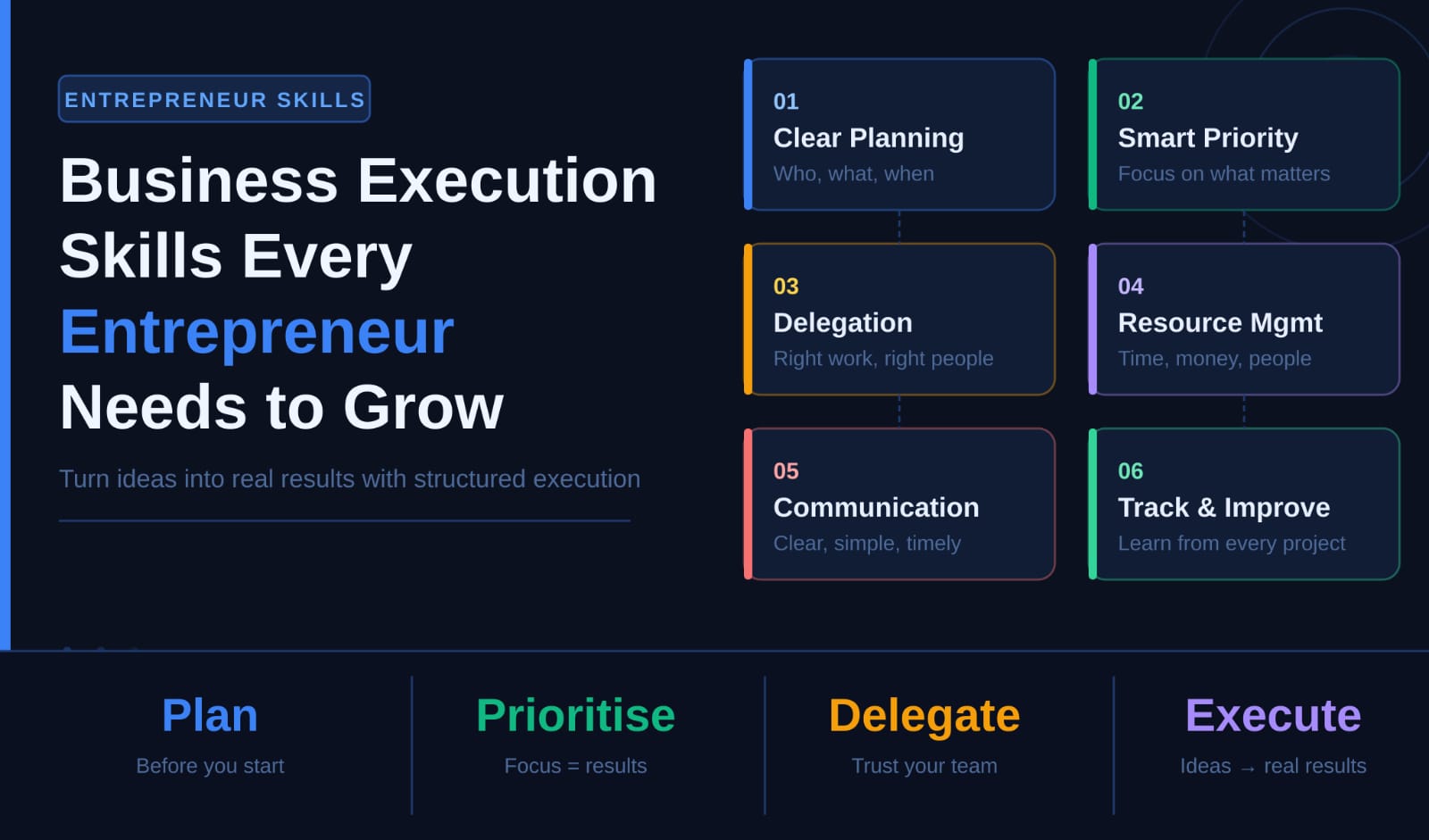
Starting a business is exciting, but running it every day is not always easy. In the beginning, most entrepreneurs depend on energy, ideas, and quick decisions. That works for some time. But once customers increase, team members join, and daily work becomes heavy, the same style may not work anymore.
This is where execution becomes important. Business execution simply means taking an idea and completing it properly. It is not about having big plans on paper. It is about making sure the right work happens at the right time, without too much confusion. Many professionals also explore Project Management Certification Training when they want to understand planning, timelines, team responsibilities, and structured execution in a better way.
Table of Contents
Why Execution Matters in Business
Every entrepreneur has ideas. Some ideas are about getting more customers, some are about improving service, and some are about launching something new. But an idea alone will not bring results. Someone has to plan it, assign the work, follow up, and finish it.
Take a simple example. A business owner wants to launch a new service. It sounds easy in discussion, but many small things have to happen before the launch. The website may need updates, the price has to be fixed, the sales team should know what to say, and customer support should be ready to answer questions.
If these things are not handled properly, the launch may get delayed or look unprofessional. The problem is not the service. The problem is poor execution.
Good execution helps entrepreneurs move step by step. It gives the team clarity and helps the owner avoid last minute pressure.
Start With a Clear Plan
Many entrepreneurs like to start quickly. That is a good quality, but starting without a clear plan can create problems later. A plan does not need to be complicated. Even a simple written note can help.
Before starting important work, the entrepreneur should be clear about a few things. What are we trying to complete? Who will do each part? When should it be finished? What support is needed? What can go wrong?
When these things are clear, people do not have to keep asking the same questions again and again. The owner also does not need to explain everything many times.
Planning saves time because it reduces confusion. It also helps the team understand why the work matters, not just what they have to do.
Know What Should Be Done First
In business, many tasks come together. A customer needs help, a payment is pending, a vendor is calling, and the team is asking for approval. If the entrepreneur tries to handle everything at the same level, the day becomes messy.
Good execution needs priority. The owner should know what needs attention first and what can wait. Usually, work related to customers, revenue, delivery, and business risk should come first.
For example, solving a customer delivery issue is more important than changing the design of a brochure. Following up on an important payment may be more urgent than discussing a future idea. This does not mean other work is not important. It only means the business should not lose focus.
When priorities are clear, the team also works better.
Give Work Clearly to the Right People
Many entrepreneurs find it hard to give work to others. They feel it is faster to do it themselves. This may be true in the beginning, but it becomes a problem as the business grows.
Delegation is not just saying, “Please handle this.” The person should know what has to be done, when it is needed, and what result is expected. If the task is not explained clearly, the output may not match what the owner had in mind.
A better way is to explain the work properly and then give the person some space to complete it. The owner can check progress at the right time, but there is no need to control every small step.
This helps the team take responsibility. It also gives the entrepreneur more time to focus on business growth.
Manage Time, Money, and People Carefully
Every business has limits. There is limited time, limited money, and limited team capacity. A growing business cannot say yes to every idea without checking whether it can actually be done.
Before starting new work, entrepreneurs should ask simple questions. Do we have enough time for this? Who will handle it? Will it affect current customers? Is there any extra cost? What happens if it gets delayed?
These questions look basic, but they can prevent big mistakes. For example, a business may run a marketing campaign but forget to prepare the team for customer calls. Another business may accept a large order without checking stock or delivery capacity.
Execution becomes stronger when resources are checked before making promises.
As businesses grow, many professionals understand that execution is not only about working harder. It is also about planning better, giving clear responsibility, and managing deadlines with discipline, which is why some learners explore project management certification training to build a stronger base in structured business execution.
Communicate in a Simple and Clear Way
Poor communication creates many business problems. Sometimes the owner explains something quickly, but the team understands it in a different way. Later, the work has to be corrected, and time is wasted.
Clear communication does not mean long meetings. It means saying the right thing in a simple way. The team should know what has to be done, who is responsible, when it is due, and what the final result should look like.
After a meeting, even a short message with action points can help. It avoids confusion and gives everyone something to refer to later.
Entrepreneurs should also make sure decisions are shared with the right people. If a price changes, the sales team should know. If a delivery date changes, customer support should know. Small communication gaps can become big business problems.
Think About Problems Early
Every business faces problems. A vendor may delay delivery, a customer may change requirements, or a team member may be unavailable. These things are normal. What matters is how early the entrepreneur notices the risk.
A simple question can help: What can go wrong here?
If the business depends on one vendor, it is better to have another option ready. If only one employee knows an important process, someone else should also learn the basics. If a campaign has a deadline, the design and content should not be kept until the last day.
Good execution is not only about solving problems after they happen. It is also about preparing early so the problem does not damage the business badly.
Track Progress Without Pressuring Everyone
Once work is assigned, the entrepreneur should not forget about it. At the same time, checking every small thing can make the team uncomfortable. A simple tracking system works better.
This can be a weekly update, a shared sheet, a task board, or a short team meeting. The method does not matter much. What matters is knowing what is done, what is pending, and where help is needed.
Tracking helps the owner see whether the work is moving properly. It also helps the team speak up before a deadline is missed.
When progress is visible, there are fewer surprises.
Keep Improving the Way Work Gets Done
Execution skills improve slowly. No entrepreneur gets everything right from day one. The goal is to learn from each project, each mistake, and each delay.
After important work is completed, the owner can ask a few simple questions. What went well? What took more time than expected? Where did the team get confused? What should we do differently next time?
This habit helps the business improve. Over time, the team becomes faster, clearer, and more confident.
Professionals who want to keep learning across business, management, technology, and career skills can also Explore Professional Learning Resources At Sterlingnext that support long term career growth.
Conclusion:
Business growth is not only about having a good idea. It is also about doing the work properly every day. Entrepreneurs need planning, priority setting, delegation, communication, and problem solving to manage growth without losing control.
When execution is weak, even a good business can feel stressful. But when execution is strong, the owner has more clarity, the team works better, and customers get a better experience.
In the long run, entrepreneurs who execute well are able to turn ideas into real results. That is what helps a business grow in a steady and practical way.

