
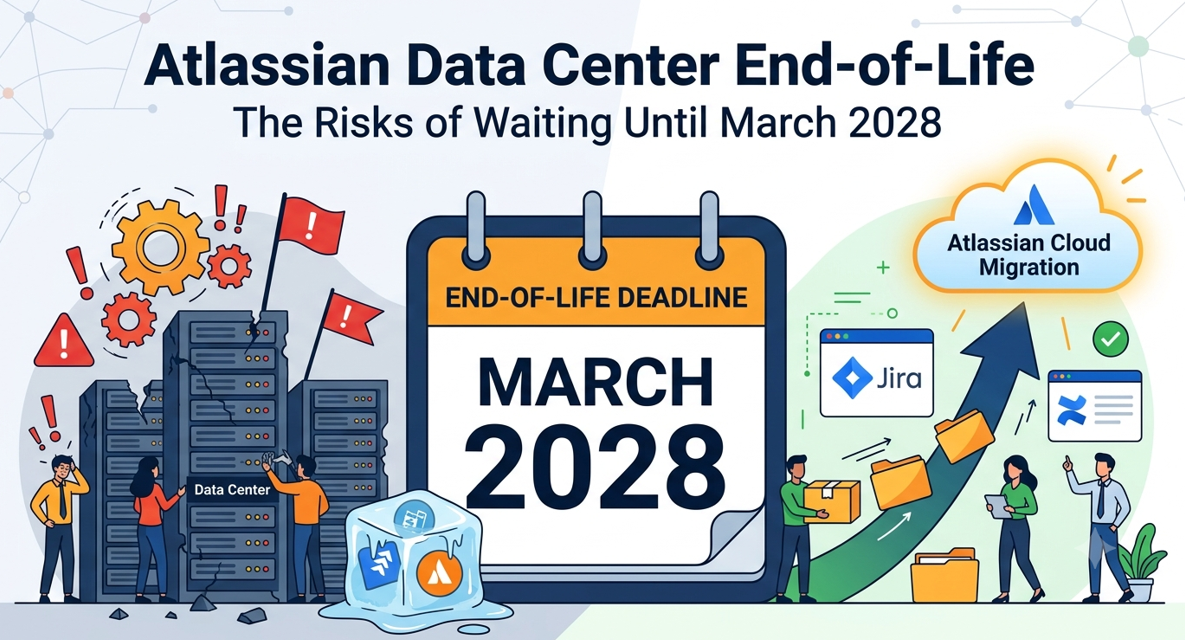
The clock is ticking louder than ever for enterprise IT leaders, infrastructure architects, and operational managers relying on self-managed Atlassian deployments. While Atlassian’s final End of Life (EOL) for Data Center support is scheduled for March 28, 2029, a much more critical milestone sits directly ahead on March 30, 2028. Transitioning from legacy environments without risking downtime or data loss requires working with a certified Atlassian solution partner to build a structured, zero-downtime migration blueprint.
On March 30, 2028, existing Data Center customers will permanently lose the ability to purchase user expansions, upgrade license tiers, or add new Marketplace apps. In essence, your custom configurations, Jira workflows, and Confluence instances will freeze in place. Any team growth or new tooling requirements beyond that point will be blocked unless you have already transitioned to the cloud.
Delaying your cloud transition strategy until the final deadline introduces severe operational, financial, and security risks that go far beyond basic software licensing.
Table of Contents
Atlassian Data Center EOL Timeline:
[March 30, 2026] –> New Data Center sales ended
[March 30, 2028] –> License expansions & new app sales freeze
[March 28, 2029] –> Final End-of-Life / Systems become read-only
Ready to safeguard your enterprise operations before the 2028 license freeze? Get a customized cloud migration assessment and evaluate your timeline today by reaching out through BuzzClan’s contact us portal.
The Unseen Bottlenecks of Last-Minute Cloud Migrations
Many technology executives assume that migrating off Atlassian Data Center is a straightforward lift-and-shift exercise that can be executed in a few weekend sprints. However, for organizations with thousands of seats, heavy custom code, and strict compliance burdens, an enterprise-grade cloud migration requires six to eighteen months of meticulous preparation.
Waiting until late 2027 or 2028 creates four major operational hazards:
1. Severe Partner Capacity Shortages
Industry surveys indicate that over 60% of remaining Data Center enterprise users plan to delay their migrations until the final 12 to 18 months before EOL. This impending rush will inevitably trigger an acute shortage of certified solution architects and migration specialists. As specialized consulting capacity gets fully booked, organizations attempting last-minute cutovers will face inflated migration costs, extended waitlists, and rushed execution schedules that compromise system stability.
2. App & Custom Integration Roadblocks
On-premises Atlassian instances rarely run on stock settings. Over years of operational growth, enterprises build custom scripts, specialized database hooks, and deep integrations with third-party toolchains like ServiceNow, Jenkins, or GitHub. Many legacy Marketplace apps available on Data Center do not have direct 1:1 functional equivalents on Atlassian Cloud Enterprise. Identifying alternative cloud apps, re-architecting custom API connections, and refactoring business workflows require months of sandbox testing to avoid breaking core developer operations.
3. Data Hygiene and Bloat Friction
Migrating decades of accumulated Jira issues, attachments, and Confluence pages without pre-migration cleanup leads to astronomical cloud storage costs, slow migration upload cycles, and corrupted data structures. Enterprise migration projects require a comprehensive “audit and prune” phase to archive inactive projects, purge duplicate custom fields, and standardize scheme configurations before a single byte of data is transferred.
4. Compliance and Security Stumbling Blocks
Transitioning core enterprise tools to multi-tenant or dedicated cloud environments demands strict governance reviews. Information security teams must evaluate cloud data residency options, single sign-on (SSO) protocols, zero-trust access, and regulatory frameworks like SOC2, FedRAMP, HIPAA, or GDPR. Rushing this security assessment at the eleventh hour can stall the entire migration pipeline right before license expiration dates hit.
A Proactive Framework for Seamless Cloud Transition
To insulate your business from license freezes and unexpected downtime, technology leaders should adopt a structured, four-phase migration framework:
- Discovery & Assessment: Conduct an exhaustive audit of your current Atlassian ecosystem. Map out user seats, instance counts, third-party app dependencies, and custom workflow schemes to determine whether your organization requires Atlassian Cloud Standard, Premium, or Enterprise.
- Cleanup & Optimization: Eliminate legacy technical debt. Archive cold projects, reduce redundant custom fields, and clean up inactive user directories to streamline the payload size.
- Staging & Dry Runs: Execute full-scale test migrations in a sandbox environment. Test critical business workflows, run integrity checks on custom scripts, and measure exact migration speed to establish an accurate cutover window.
- Zero-Downtime Production Cutover: Schedule the final production migration during low-volume operational hours, ensuring complete data synchronization, user mapping, and rapid post-migration support.
Modernizing Your Infrastructure with the Right Partner
Successfully transitioning from legacy Data Center deployments to high-availability cloud environments requires deep domain expertise, proven migration blueprints, and dedicated post-migration support. Aligning with an experienced solution partner early ensures your organization stays ahead of the March 2028 expansion freeze, optimizes platform configurations, and automates cloud governance without risking business continuity.
READ ALSO: Data Analyst Resume: Examples, Skills, Format, and Tips for 2026

