
Automation gets pitched as a cure-all. Faster throughput, fewer errors, lower labor costs, a shop floor that runs itself. Some of that is real. But plenty of automation projects underdeliver, not because the technology failed, but because the wrong questions were asked before anyone signed off on the spend.
Production line automation is a serious capital decision, and the cost of getting it wrong is not just the price of the machine. It is the downtime during a botched integration, the operators who quietly work around a system they do not trust, and the months of production the project was supposed to improve. Before committing budget, it is worth slowing down and pressure-testing the decision.
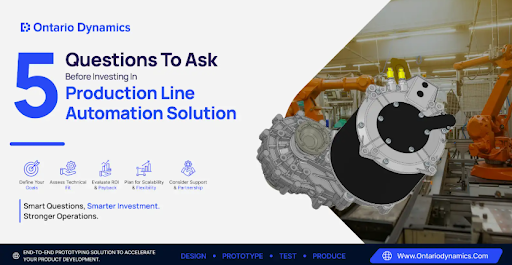
Here are five questions that separate automation investments that pay off from the ones that become expensive regrets.
Table of Contents
1. What problem are you actually solving?
This sounds obvious, and it is the one most often skipped. Companies frequently decide to automate a station because it feels outdated or because a competitor did so, not because they have identified the specific problem automation is meant to fix.
There is a real difference between automating a bottleneck, automating a quality issue, and automating a labor gap. Each points to a different solution. If the true problem is inconsistent quality, throwing a faster machine at the line may just produce defects more quickly. If the problem is a poorly defined process to begin with, automating it locks the dysfunction in place and makes it harder to change later.
Before evaluating any automation solution, get specific. What exactly is failing today? How is it measured? What would success look like in numbers, whether that is cycle time, scrap rate, or units per shift? If you cannot answer those clearly, you are not ready to buy anything yet. You are ready to study your own process.
2. Off-the-shelf or custom, and why?
Once the problem is clear, the next fork is whether a standard, off-the-shelf system can solve it or whether the job calls for a custom, special-purpose machine.
Off-the-shelf automation is faster to deploy and usually cheaper up front. When your process matches what the equipment was designed for, it is often the right call. The trouble starts when a standard machine is forced onto a process it does not quite fit. Teams end up modifying their workflow to suit the machine, adding manual steps around it, or accepting compromises that erode the value they were chasing.
Custom automation flips that relationship. A special-purpose machine is built around your exact workflow, constraints, and part geometry, which means it can automate tasks a generic system cannot handle well. The trade-off is a higher initial investment and a longer lead time. The question is not which approach is better in the abstract, but which one fits the specific task, volume, and part mix you are dealing with. A useful test: if adopting a standard machine would require you to change how you actually make your product, that is a strong signal you may need something built for the job.
3. What is the real ROI, including the costs nobody quotes?
The ROI math on automation is often done on the sticker price of the equipment against the labor it replaces. That calculation almost always flatters the project, because the sticker price is only part of what automation actually costs.
The costs that get left out are the ones that hurt later. Integration into your existing line takes engineering time and often some production downtime. Commissioning and debugging rarely go perfectly on the first pass. Operators and maintenance staff need training. The machine needs spare parts, servicing, and a plan for what happens when it goes down. And there is the opportunity cost of the disruption while the new system beds in.
A more honest ROI model accounts for the total cost of ownership over the machine’s working life, not just the purchase. It also weighs the cost of doing nothing, since a bottleneck left in place has its own ongoing price. The point is not to talk yourself out of automating. It is to decide with the real numbers, so the payback timeline you present to leadership is one the project can actually meet.
4. Will it integrate with what you already have?
A machine that works beautifully in isolation can still be a failure on your floor if it does not fit the system around it. Integration is where a surprising number of automation projects run into trouble.
Think through the physical and the digital. Physically, does the equipment fit the available footprint, and does material flow into and out of it cleanly, or does it create a new bottleneck upstream or downstream? Digitally, how does it talk to your existing controls, your other machines, and any data or quality systems you rely on? Automation that cannot share data with the rest of the line is a missed opportunity at best and an integration headache at worst.
There is a human side too. The people who run the line have to be able to operate, monitor, and troubleshoot the new system. Automation designed without input from the operators and maintenance team often gets resisted or worked around, which quietly kills the return you were counting on. The best automation projects involve the floor team early, so the system supports how work actually happens rather than fighting it.
5. Who supports it after the install?
The day the machine is installed is the beginning of its working life, not the end of the project. Yet support is often an afterthought in the buying decision, which is a mistake you only notice when something breaks.
Ask what happens after commissioning. Is there documentation your team can actually follow, including clear drawings, bills of materials, maintenance procedures, and commissioning records, or a binder nobody can decipher? When the machine goes down at an inconvenient hour, who do you call, and how fast can they help? Are spare parts available, and is the design something your own maintenance staff can service, or does every issue require the original builder?
Good documentation and real post-delivery support are what determine whether an automation investment keeps performing for years or becomes a maintenance liability. When you evaluate a provider, weigh their support model as heavily as their engineering. A slightly more expensive solution that comes with usable documentation and responsive support will almost always beat a cheaper one that leaves you stranded after installation.
The common thread
Notice that only one of these five questions is really about the machine itself. The rest are about your process, your numbers, your existing systems, your people, and the years after installation. That is the heart of it. Successful production line automation is far less about picking impressive equipment and far more about understanding your own operation well enough to know exactly what you need and what it will take to make it work.
Automation can deliver enormous value. But the projects that succeed are the ones where the hard thinking happened before the purchase order, not after the machine arrived. Ask these questions early, be honest about the answers, and you will either build a strong case for automating or discover that your money is better spent somewhere else. Either outcome is a win.

