

Choosing the right online marketing tools can feel overwhelming. With thousands of platforms competing for your attention and budget, it’s difficult to know which ones will actually deliver results. The right toolkit can transform scattered efforts into cohesive campaigns, turn manual processes into automated workflows, and replace guesswork with data-driven decisions.
To stay competitive, marketers need a curated set of tools that can adapt to constant change while delivering measurable outcomes. This guide cuts through the noise, examining ten essential online marketing tools that have proven their value. Each tool has been selected for its ability to solve real marketing challenges, deliver tangible results, and adapt to the evolving digital landscape. We will explore each platform’s best features and offer a special tip to help you get the most out of it.
Table of Contents
1. Bulkly: AI-Powered Social Media Automation
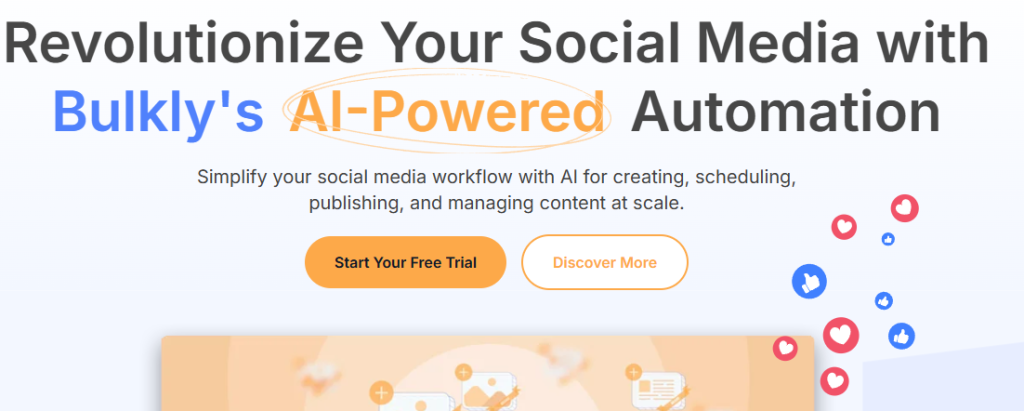
Maintaining a consistent social media presence across multiple platforms is one of the biggest challenges marketers face. Bulkly revolutionizes social media management by blending artificial intelligence with powerful scheduling capabilities. It allows you to automate content creation and scheduling without sacrificing quality.
Best Features:
- AI-driven content creation: Integrates with ChatGPT to generate engaging social media posts tailored to your brand voice.
- Automatic post recycling: Maximizes the lifespan and reach of your evergreen content by automatically reposting it.
- RSS feed integration: Instantly curates and shares relevant content from your favorite blogs and news sources.
- Unlimited posts: All pricing tiers allow for an unlimited number of scheduled posts, offering great value.
Special Tip: Use the AI content generation feature to create multiple variations of a single post. This keeps your feed fresh when recycling content and helps you A/B test different messaging styles to see what resonates most with your audience.
2. Privyr: Mobile-First CRM and Lead Management
Privyr combines customer relationship management (CRM) with robust lead tracking, designed specifically for small to medium-sized businesses. It offers professional CRM functionality without the enterprise-level complexity, making it a tool your sales team will actually use.
Best Features:
- Integrated lead capture: Automatically imports leads from various sources like email, social media, and web forms.
- Automated follow-up sequences: Creates and sends personalized follow-up messages to nurture leads without manual effort.
- Mobile-first design: Its strong mobile app is perfect for on-the-go management, especially for remote or field sales teams.
- Pipeline visualization: Provides a clear, visual way to track deals and manage your sales pipeline from start to finish.
- WhatsApp Auto-Responders: Allows users to automatically respond to new leads on WhatsApp regardless of the lead source.
Special Tip: Customize your automated follow-up messages to include a personal touch. For example, reference the specific ad or form the lead came from. This small detail can significantly increase engagement and response rates.
3. Ranktracker: Comprehensive SEO Analysis
Understanding your website’s performance in search results is critical for driving organic traffic. Ranktracker provides detailed search engine optimization (SEO) insights, helping you track your rankings, analyze competitors, and identify opportunities for improvement.
Best Features:
- Accurate keyword position tracking: Monitors your website’s rankings for target keywords across multiple search engines and locations.
- Competitor analysis: Compares your SEO performance against your top competitors to identify strategic gaps and opportunities.
- Website audit functionality: Scans your site for technical SEO issues that could be hurting your rankings and provides actionable recommendations.
- Backlink monitoring: Tracks your backlink profile and analyzes your competitors’ backlinks to find new link-building opportunities.
Special Tip: Use the competitor analysis feature to find “keyword gaps”—keywords your competitors are ranking for, but you are not. This is a quick way to discover new content ideas with proven demand.
4. Google Search Console: The SEO Foundation
Google Search Console is the most authoritative source for understanding how Google sees your website. This free and indispensable tool offers direct data from Google about your site’s health, performance, and visibility in search results.
Best Features:
- Search performance data: Provides official data on clicks, impressions, click-through rate (CTR), and average ranking positions for your pages and keywords.
- Index coverage reports: Shows which pages of your site have been successfully indexed by Google and alerts you to any crawling or indexing errors.
- Core Web Vitals monitoring: Tracks your site’s performance on key user experience metrics that are part of Google’s ranking algorithm.
- Security issue alerts: Notifies you of any security issues, such as hacking or malware, detected on your site.
Special Tip: Regularly check the “Performance” report and filter for queries where your site has a high number of impressions but a low CTR. This indicates that your page is visible but the title tag isn’t compelling enough. Rewriting these titles can lead to a quick traffic boost.
5. Google Analytics: Website Intelligence Platform
Google Analytics is the industry standard for understanding website traffic and user behavior. With the transition to Google Analytics 4 (GA4), the platform now offers more sophisticated, event-based analysis to give you a deeper understanding of the customer journey.
Best Features:
- Detailed traffic source analysis: Shows you where your visitors are coming from, whether it’s organic search, social media, or paid campaigns.
- User behavior flow visualization: Maps out the paths users take through your website, helping you identify popular pages and drop-off points.
- Custom goal and conversion tracking: Allows you to measure the actions that matter most to your business, such as form submissions or purchases.
- Audience segmentation: Lets you group your audience based on demographics, behavior, or traffic source for more granular analysis.
Special Tip: Create custom “Explorations” in GA4 to build reports that answer specific questions about your business. For example, build a Funnel exploration to see exactly where users are dropping off in your checkout process.
6. Mailchimp: All-in-One Email Marketing
Mailchimp has grown from a simple email tool into a comprehensive marketing automation platform. It remains one of the most accessible and user-friendly options for businesses of all sizes, especially those just starting with email marketing.
Best Features:
- Drag-and-drop email builder: An intuitive interface that makes it easy to create professional-looking emails without any coding knowledge.
- Advanced automation workflows: Build sophisticated email sequences triggered by user behavior, such as welcome series or abandoned cart reminders.
- Audience segmentation tools: Group your subscribers based on their interests, purchase history, or engagement level to send more targeted messages.
- A/B testing capabilities: Test different subject lines, content, and send times to optimize your email campaign performance.
Special Tip: Use Mailchimp’s “Customer Journey Builder” to visualize and create automated, multi-step workflows. For instance, you can design a journey that sends a series of educational emails to new subscribers, followed by a special offer to encourage their first purchase.
7. SlideModel AI: Professional Presentation Maker
Presentations are a vital part of marketing, from sales pitches to campaign reports. SlideModel AI simplifies the creation of professional slide decks by with AI to suggest layouts, content, and visuals, helping you build compelling presentations in minutes.
Best Features:
- AI-powered slide suggestions: Generates slide structures, content, and designs based on a simple text prompt or an existing document.
- Fully editable templates: Provides a vast library of high-quality, 100% customizable templates for various business needs.
- AI image and icon generation: Creates custom visuals directly within the platform to perfectly match your presentation’s content.
- Export to PowerPoint and Google Slides: Seamlessly integrates with major presentation software for easy sharing and collaboration.
Special Tip: Use the feature that turns documents into presentations. Upload a blog post or a whitepaper, and SlideModel AI will automatically generate a structured slide deck summarizing the key points, saving you hours of manual work.
8. Canva: Fast and Easy Visual Content Creation
Canva has made graphic design accessible to everyone. It’s an indispensable tool for marketers who need to create professional-looking visuals for social media, ads, presentations, and more, without needing extensive design skills.
Best Features:
- Extensive template library: Offers thousands of templates for nearly every type of content, from Instagram stories to business reports.
- Drag-and-drop design interface: A highly intuitive editor that makes it easy to customize templates and create designs from scratch.
- Brand Kit: Allows you to store your brand’s colors, fonts, and logos to ensure consistency across all your marketing materials.
- Team collaboration tools: Enables multiple team members to work on designs simultaneously and leave comments.
Special Tip: Use Canva’s “Magic Switch” feature to instantly resize one design for multiple platforms. Create a single graphic for an Instagram post, and with one click, transform it into a Facebook banner, a Twitter header, and a LinkedIn post.
9. VanillaSoft: Sales Engagement and Prospecting
For teams focused on high-volume outbound prospecting, VanillaSoft is a sales engagement software designed to streamline the entire process. It helps sales teams engage with leads more effectively and improve their conversion rates through a suite of productivity-focused tools.
Best Features:
- Intelligent lead routing: Automatically prioritizes and distributes leads to the right sales reps, ensuring quick follow-up.
- Built-in auto-dialer: Increases call efficiency by automatically dialing the next lead in the queue, minimizing downtime.
- Email and call activity tracking: Provides a complete history of all interactions with a lead, giving reps valuable context for their conversations.
- Robust reporting and analytics: Offers insights into team performance, call outcomes, and campaign effectiveness to inform your strategy.
Special Tip: Leverage the call scripting feature to create dynamic scripts that guide reps through conversations. You can include different branches based on the lead’s responses, ensuring a consistent and effective message while still allowing for natural conversation.
10. SEMrush: All-in-One Digital Marketing Intelligence
SEMrush is a comprehensive digital marketing suite that provides deep insights into SEO, paid advertising, content marketing, and social media. It is particularly powerful for its competitive intelligence features, allowing you to analyze your competitors’ strategies in detail.
Best Features:
- Extensive keyword research database: Access a massive database of keywords to find opportunities for both organic and paid campaigns.
- Competitor advertising intelligence: See the ads your competitors are running, the keywords they’re bidding on, and their ad copy.
- Site audit and technical SEO tools: Performs in-depth technical audits of your website to identify and help you fix issues that could impact your rankings.
- Content gap analysis: Compares your content to your competitors’ to find topics that you’re missing but they are ranking for.
Special Tip: Use the “Keyword Magic Tool” and apply the “Questions” filter to find common questions your target audience is asking. Creating content that directly answers these questions is a great way to capture featured snippets on Google and attract highly-qualified traffic.
Building Your Ideal Marketing Toolkit
The most effective marketing toolkit is one that is tailored to your business’s specific goals, budget, and team expertise. Start by identifying your biggest challenges. If content creation is a bottleneck, focus on AI-powered tools. If social media drives most of your leads, a comprehensive management platform should be a priority.
Remember that the best tool is the one your team will consistently use to its full potential. Look for platforms with intuitive interfaces, strong support, and the ability to integrate with other tools in your stack. By making strategic choices, you can build a marketing technology stack that not only solves today’s problems but also scales with your business as you grow.

