
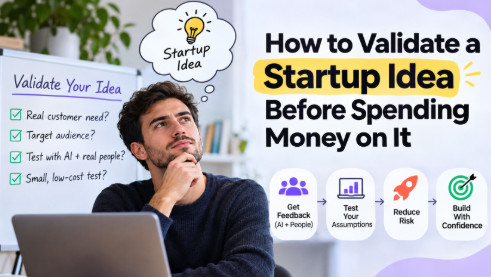
Starting a startup is fun. You have an idea. You think about the website. You think about the logo. You think about the product. You think about how you’re going to acquire customers.
Sometimes, you get caught up in the moment so much that you forget to ask one simple question.
Who wants what I’m building?
This is one of the biggest mistakes people make when starting a business. They invest money to build something without really knowing if there’s any demand for it.
This doesn’t just apply to big startups either. It applies to Shopify stores. It applies to mobile apps. It applies to online services. It even applies to advertising.
The silver lining is that you don’t even need a lot of money to start validating startup ideas.
Table of Contents
A Good Idea Isn’t Necessarily a Good Business
Imagine you had an idea for an app that helped people find car detailing services in their area.
You think it’s a good idea. Your friends say they’d use it. You hire a developer. You build the app. You spend a few thousand dollars in the process.
Here’s the thing.
Do people even have trouble finding car detailing services? Would they even download an app for this? Would they pay extra to be convenient? What are they using now?
All of these things are more important than how pretty your app is.
That’s why startup idea validation should be the first thing you think about when you have an idea.
You don’t need to know if your startup idea is good. You just need to know what assumptions could potentially break your business.
Focus on the Customer First, Then the Product
When you’re validating startup ideas, the first three things you should ask yourself are:
- Who exactly does this product need?
- What problem are they facing?
- Why would they choose this over what they’re currently using?
Specificity is key.
“Everyone who owns a car” is not a specific target audience.
“People who live in apartments and don’t have the time to go to a car wash” is.
When you know who you’re building your product for, it becomes a lot easier to know what you should validate.
This strategy works for any type of business idea, whether you’re building a SaaS product, a dropshipping store, a mobile app, or even a local service.
AI Is Changing the Way People Brainstorm Business Ideas
One thing that has changed is how people use AI to brainstorm business ideas.
Asking ChatGPT for competing products, reasons someone might not like your idea, or questions to ask customers is now commonplace.
There are also AI startup idea validation tools that allow entrepreneurs to more deeply explore potential customer reactions to their startup ideas.
SellTo.us, for instance, is a platform that allows entrepreneurs to test startup ideas, products, apps, services, and even advertising ideas using AI simulated audiences.
Entrepreneurs describe their startup idea and receive simulated feedback on potential customer interest, reasons someone might not like the idea, and ways the idea might be improved.
There’s also a free test you can take with 100 AI simulated customers.
The one caveat with AI feedback and AI simulated customer feedback is that…
AI simulated customers are not real customers.
They cannot be used to prove someone will buy your product. They cannot be used to predict sales.
That being said, it can still be helpful to use AI feedback to figure out what questions you should ask before spending money.
Maybe your price point is too high. Maybe your target audience is too broad. Maybe your product description isn’t compelling.
All of this matters.
The Difference Between AI Feedback and Real Demand
While AI focus groups and simulated customer feedback can be helpful for brainstorming, it’s still not a replacement for real market research.
Real validation requires real customers.
Here are a few simple ways to validate a business idea:
Conduct customer interviews. Identify people who currently face the problem you’re trying to solve and ask them how they currently deal with it.
Build a landing page. Describe your product and see if people are interested enough to sign up for a waitlist.
A/B test headlines or offers. Have two different headlines or offers and track what happens.
Run a small ad campaign. If you have the budget, run an ad targeting the right audience to see if people click and take meaningful action.
Ask for a real commitment. Get a preorder. Get a paid pilot. Have a serious sales conversation.
All of these are valid ways to validate an idea.
The difference is that you don’t need to do all of them at once.
Start small with the least expensive test you can that will answer your most pressing question.
How to Validate a Product Before Running Ads (If You’re Dropshipping)
This all applies to e-commerce as well.
Imagine you found a product you wanted to sell on a Shopify store.
Before buying inventory or spending hundreds of dollars on Facebook ads, you should ask yourself who might want this product and why.
What problem does it solve? Is the price point right? Is it different enough from other products? What would prevent someone from buying it?
Using AI product concept testing, you can explore all of these questions and then use real customer behavior to validate your assumptions.
Maybe you want to A/B test two product descriptions. Maybe you want to build a landing page. Maybe you want to run a small ad campaign.
All of these things are valid.
The point is not that there’s no risk. There is always risk.
The point is not to spend money before you answer the most basic questions you have about your business.
How Much Money Should You Spend Validating an Idea?
There is no magic number.
If you’re building a simple online service, customer interviews and a landing page may be all you need.
If you’re making a physical product that needs to be manufactured, you may need to do more work before buying inventory.
The takeaway here is to start small with your first test.
Don’t spend $5,000 to validate something you could have validated with a few customer interviews or a test.
Don’t spend weeks perfecting your product only to learn that people don’t understand why they need it.
Final Thoughts
You don’t need to have everything together to launch a business.
What you do need to have is an understanding of the assumptions you’re making.
Who needs your product? Why would they choose your product? What would make them not want your product? Most importantly, what would it take to convince you that your idea was worth pursuing?
Use ChatGPT to brainstorm. Use AI simulated focus groups to identify potential objections. Talk to real customers. Do small tests.
Remember, getting positive feedback isn’t the same thing as having a business.
The goal isn’t to get confirmation that your idea is good. The goal is to learn something before you spend your money.

