
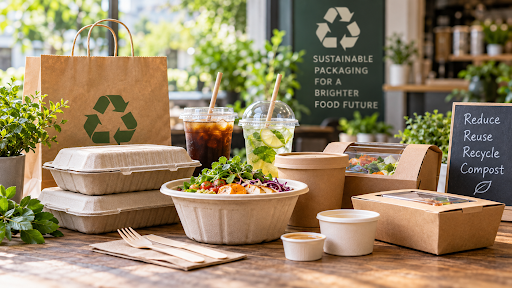
For cafés, takeaways, caterers and food brands, sustainable packaging is no longer simply a question of choosing paper instead of plastic. The real challenge is finding packaging that works commercially, operationally and environmentally at the same time.
For years, sustainable packaging decisions were often led by a simple question: which material looks greener?
That question is becoming less useful.
For food businesses, packaging sits at the intersection of cost, customer experience, compliance, storage, transport and waste. A container can be made from a renewable material and still fail if it leaks during delivery. A cup can appear recyclable but be difficult to process in the local waste system. A compostable product may perform well in service but offer limited environmental benefit if there is no suitable collection or treatment route.
For small and medium-sized businesses in particular, the better question is now:
Which packaging system actually works for the product, the operation and the market in which it will be used?
Table of Contents
Packaging performance comes before material preference
Food packaging has a practical job to do before anything else.
A takeaway container may need to withstand hot food, oil, sauce, steam, stacking and 30 minutes of transport. A cold-drink cup needs clarity, rigidity and reliable lid compatibility. A soup container needs to maintain its structure while resisting heat and moisture.
These requirements are very different.
That is why choosing packaging by material name alone can create problems.
Two paper bowls may look almost identical but use different barrier coatings. Two fibre containers may react differently to hot oil. A lid that fits well when cold may deform or loosen when exposed to heat. Venting that works for dry food may be unsuitable for a meal producing large amounts of steam.
Beverage packaging brings another set of requirements. Cup clarity, wall strength, lid compatibility, print quality and filling temperature can all affect the final specification.
For cafés, juice bars and beverage chains,manufacturers who focus on PET, PLA and customised drink cups, where material choice, lid systems and branding requirements need to be considered together.
For operators, the most useful packaging specification therefore begins with the application rather than the material.
Businesses should define:
- food or drink type;
- filling temperature;
- oil and moisture level;
- required holding time;
- delivery distance;
- stacking requirements;
- microwave or reheating needs;
- lid type;
- and expected disposal route.
Only then does it make sense to compare paper, moulded fibre, PP, PET, PLA or other alternatives.
The cheapest unit price is not always the lowest-cost option
Packaging buyers naturally compare prices per cup, tray or container.
But unit price tells only part of the story.
Poorly matched packaging can create hidden costs through leakage, damaged meals, customer complaints, double-packaging and wasted stock.
A slightly cheaper food box can become an expensive choice if staff regularly need to add an outer bag to prevent leakage. A low-cost lid becomes less attractive if fitting it slows down service during busy periods. Oversized cartons can also increase warehouse space and logistics costs.
For growing businesses, the more useful calculation is the total operational cost per served meal or drink.
That includes not only the purchase price but also:
- packing speed;
- failure rate;
- storage efficiency;
- transport volume;
- product waste;
- staff handling;
- customer complaints;
- and disposal costs.
This becomes especially important when a company moves from small local purchasing to higher-volume supply contracts.
At that point, small differences in packaging performance can have a measurable effect across thousands or even millions of units.
Regulation is becoming part of procurement
Packaging decisions are also becoming more closely connected with regulation.
In the UK and across Europe, businesses are facing greater scrutiny over packaging waste, recyclability, producer responsibility and environmental claims.
Extended producer responsibility requirements are changing how packaging waste costs are allocated, while recyclability assessments are encouraging companies to pay closer attention to the materials and structures they place on the market.
Even businesses that are not directly responsible for every regulatory obligation can feel the effects through suppliers, customers and larger corporate buyers.
This changes the questions procurement teams need to ask.
Instead of simply requesting a statement that a product is “eco-friendly”, businesses increasingly need to understand:
- what the packaging is actually made from;
- whether coatings or barriers are present;
- whether food-contact documentation is available;
- what environmental claims can reasonably be made;
- whether the packaging is recyclable or compostable in the intended market;
- and how a supplier controls material changes between production runs.
The result is a more technical purchasing process, but also a more defensible one.
Compostable, recyclable and reusable are different systems
One of the most common mistakes in sustainable packaging is treating all environmental alternatives as interchangeable.
They are not.
Recyclable packaging depends on collection, sorting and recycling infrastructure.
Compostable packaging depends on suitable organic-waste collection and composting conditions.
Reusable packaging requires a return system, washing, inventory management and enough reuse cycles to justify the additional material and operational effort.
Each approach can work well under the right conditions.
The important point is that the packaging and the disposal system have to match.
For example, a closed university campus or corporate canteen may be able to control collection and washing, making reusable packaging practical.
A takeaway restaurant serving customers across a large city has much less control over what happens after the packaging leaves the premises.
In that environment, recyclable paper, fibre or conventional plastic formats may sometimes be easier to manage than a theoretically preferable system that customers cannot access.
Sustainability therefore needs to be evaluated in the context of the entire operating model.
Suppliers need to understand the application, not just the catalogue
The relationship between buyer and packaging supplier is changing as a result.
A supplier that simply sends a catalogue and price list can still fulfil straightforward requirements, but more complex foodservice applications require more discussion.
Manufacturers such as Bioleader increasingly work across moulded fibre, paper and compostable foodservice packaging rather than assuming that one material is suitable for every application.
For buyers, the most productive supplier conversations usually begin with the food and operating conditions.
A useful sourcing brief might state:
“Hot noodle dish, approximately 90°C at filling, oily sauce, 30-minute delivery, stackable container, transparent lid preferred.”
That gives a supplier far more useful information than:
“We need an environmentally friendly 1,000ml food container.”
The more precise the application, the easier it becomes to compare samples fairly.
Test packaging with real food
Specifications and certificates are important, but operational testing should not stop there.
One of the simplest ways for food businesses to reduce packaging mistakes is to test products with the actual menu item.
Fill the container at the normal serving temperature.
Add the real sauce.
Close the lid.
Stack it as staff would during a busy service.
Leave it for the expected delivery time.
Then tilt, carry and open it.
This basic test often reveals problems that are not obvious from a catalogue or laboratory specification.
Businesses introducing new packaging across multiple locations can make this process more systematic by recording temperature, holding time, leakage, deformation and lid performance.
That creates a repeatable approval process rather than relying on subjective impressions.
Start with high-volume items
Moving towards more sustainable packaging does not require a complete overnight replacement of every item.
For many SMEs, a better approach is to begin with the products used most frequently.
That might include:
- takeaway food containers;
- hot cups;
- cold-drink cups;
- salad bowls;
- cutlery;
- or delivery bags.
Improving a high-volume item can create a larger practical impact than replacing a rarely used product simply because an alternative is available.
It also gives the business an opportunity to test supplier reliability, customer reaction and operational performance before expanding the programme.
The best packaging strategy is rarely based on one material
The next stage of sustainable packaging is likely to be less about finding a single “perfect” material and more about choosing the right format for each operating situation.
Paper may work well for one application.
Moulded fibre may suit another.
Recyclable plastics may remain practical where transparency, moisture resistance or closed-loop recycling are important.
Reusable systems may make sense where collection can be controlled.
The companies that make better decisions will be those that stop asking whether a material is simply good or bad and instead evaluate packaging through a combination of performance, infrastructure, compliance and cost.
For SMEs already dealing with rising labour, energy, logistics and regulatory pressures, that distinction matters.
Packaging may appear to be a small purchasing category.
In practice, it touches almost every part of the customer journey — from the moment food is packed to the moment the empty container is discarded.
And that makes sustainable packaging not simply an environmental choice, but an operational one.

