
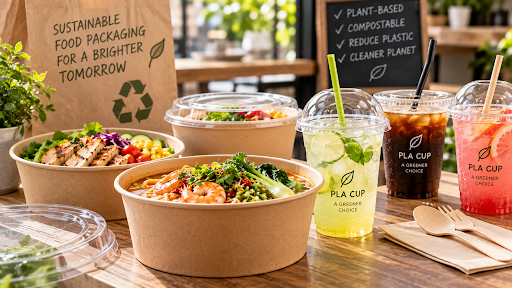
For restaurants, cafés, takeaway operators and beverage brands, sustainable packaging is no longer limited to replacing plastic with paper.
A modern takeaway order may involve several different packaging systems at once: a paper bowl for hot food, a clear cup for an iced drink, a lid, cutlery and an outer delivery bag.
Each component has different performance requirements.
That means businesses need to think beyond whether a package is simply described as recyclable, compostable or plant-based.
The more useful question is whether the packaging works with the actual food, beverage, delivery process and waste system.
Two formats illustrate this particularly well: takeaway paper bowls and PLA cold-drink cups.
Both are increasingly visible in modern foodservice, yet both require more technical specification than their simple appearance suggests.
Table of Contents
Why takeaway paper bowls have become a foodservice staple
Paper bowls have become common across takeaway food, meal delivery and casual dining because they can handle a wide range of products while providing a familiar paper-based appearance.
They are now used for salads, rice dishes, noodles, pasta, soups, poke bowls, desserts and many other applications.
But “paper bowl” is not a complete specification.
The paperboard itself is only one part of the construction.
The internal barrier layer, bowl geometry, rim design, lid compatibility and intended food temperature all affect how the package performs.
A bowl used for a cold salad does not face the same conditions as one filled with hot curry or oily noodles.
For that reason, buyers comparing takeaway paper bowls should begin with the actual food application rather than choosing a container based only on capacity.
Heat, oil and moisture need to be considered together
Food packaging rarely deals with only one type of stress.
A hot takeaway meal may expose the bowl to heat, water, oil and steam at the same time.
A bowl that performs well with dry rice may behave differently when filled with a tomato sauce or curry.
Likewise, a container that resists water may still show grease staining when used for fried or oily food.
Holding time also matters.
There is a significant difference between packaging that needs to perform for ten minutes at a takeaway counter and packaging used for a 45-minute delivery journey.
When evaluating paper bowls, food businesses should therefore define the complete operating condition.
For example:
“900ml bowl for hot noodles, approximately 85°C at filling, oily sauce, 30-minute delivery, transparent lid required.”
That is much more useful than simply asking for an “eco-friendly 900ml bowl”.
The coating is part of the package
Paper food packaging often requires a barrier layer to handle liquids, grease or heat.
This layer can affect not only performance but also the environmental characteristics of the finished package.
Different bowl constructions may use different types of coatings or barriers.
The choice can influence water resistance, oil resistance, heat tolerance, recyclability, compostability and food-contact documentation.
Businesses should therefore avoid assuming that two paper bowls are equivalent simply because both look like kraft paper or white paperboard.
The internal structure may be different.
For larger procurement programs, the coating specification should be recorded alongside bowl size, material weight and lid type.
This helps prevent unexpected changes when a supplier modifies a product specification.
Lid compatibility can determine whether the bowl succeeds
The lid often receives less attention than the bowl itself.
In takeaway operations, that can be a mistake.
A poor lid fit can cause leakage, reduce stacking stability and slow staff during busy service periods.
Different food applications may require different lid systems.
Hot foods may need venting.
Salads and display meals may benefit from transparent lids.
Delivery meals may need stronger locking performance.
Some food businesses may also prefer paper lids where possible, while others prioritise the visibility provided by PET or PP lids.
The correct choice depends on the operating environment.
A sustainable bowl with a lid that repeatedly fails during delivery is unlikely to remain in use for long.
Real-food testing is more useful than looking at empty samples
Packaging samples often look excellent when they are empty.
Real service conditions are much more demanding.
Before approving a paper bowl, operators should test the container with the actual menu item.
Fill it at the normal serving temperature.
Add the real sauce or dressing.
Fit the intended lid.
Stack it the way employees would during peak service.
Leave it for the expected delivery time.
Then check the bowl for softening, leakage, oil penetration, deformation and lid movement.
That simple process often identifies problems that are difficult to see from product specifications alone.
Beverage packaging brings a different set of requirements
Cold-drink packaging operates under a different set of conditions.
For iced coffee, smoothies, juice, bubble tea and fruit drinks, transparency is often important because the beverage itself is part of the visual customer experience.
This is one reason PLA has attracted attention in beverage packaging.
PLA, or polylactic acid, can be manufactured into transparent cups that resemble conventional plastic cold cups while using a bio-based polymer.
However, it is important to remember that PLA is still a plastic polymer.
It is not simply paper in another form, and its environmental performance depends on appropriate treatment conditions.
PLA cups are primarily a cold-drink solution
PLA has different heat behaviour from materials such as PP.
That makes temperature specification particularly important.
Businesses should not assume that a clear compostable cup can automatically replace every transparent plastic cup in an operation.
PLA is generally most suitable for cold beverage applications.
These may include iced coffee, cold tea, juice, smoothies, milkshakes and similar drinks.
The cup should be evaluated together with the beverage temperature, ice content, storage conditions and delivery time.
For cafés and beverage chains purchasing PLA cups, the most important technical questions often concern cup diameter, lid compatibility, printing, storage and the intended waste route.
A compostable cup still needs a composting system
The word compostable is frequently misunderstood.
A compostable cup does not automatically break down quickly wherever it is discarded.
Industrial composting relies on controlled conditions involving temperature, moisture, oxygen and biological activity.
Local collection infrastructure therefore matters.
A compostable packaging program may work particularly well in a controlled venue where food waste and packaging are collected together.
Festivals, campuses, corporate catering locations and closed hospitality environments may be able to establish such systems more easily.
In a public takeaway environment, the business has much less control over what happens once the customer leaves.
That does not make compostable packaging unsuitable, but it does mean businesses need realistic end-of-life expectations.
Cup and lid standardisation can reduce operational complexity
Cup purchasing should not focus on capacity alone.
Two cups described as 12oz may not share the same top diameter.
That means their lids may not be interchangeable.
For a beverage chain using several sizes, standardising rim diameters where possible can reduce the number of lid SKUs that need to be stocked.
This can simplify procurement, warehousing and staff training.
Operators should therefore compare cup diameter and lid specification rather than assuming all cups of the same nominal volume are identical.
The same principle applies to dome lids, flat lids, straw openings and sealing-film systems.
Printing turns packaging into a branding asset
Food and beverage packaging is also becoming part of the customer’s brand experience.
Takeaway bowls may carry a restaurant logo.
Cold cups may include brand colours, graphics or seasonal designs.
For businesses with strong takeaway sales, packaging can become one of the most frequently seen physical expressions of the brand.
However, printing adds another layer to the specification.
Artwork size, colour tolerance, print position, minimum order quantity and production lead time need to be considered before an order is placed.
A company operating several bowl or cup sizes may also need to decide whether each format uses identical artwork or a size-specific version.
This becomes particularly important when purchasing packaging in large volumes from overseas manufacturers.
Sustainable packaging should be evaluated as a system
Paper bowls and PLA cups are good examples of why sustainable packaging decisions should not be reduced to one material claim.
A paper bowl may perform extremely well in one application and poorly in another.
A PLA cup may be appropriate for cold beverages but unsuitable for higher-temperature use.
A compostable package may make sense where collection infrastructure exists, while another market may favour recyclable formats.
There is rarely one material that is automatically the best option for every operation.
The more useful approach is to evaluate four factors together:
product performance, operating conditions, waste infrastructure and commercial practicality.
Better specifications lead to better packaging decisions
Food businesses can often improve procurement simply by giving suppliers more precise information.
Instead of requesting:
“Please quote your sustainable bowls and cups.”
a buyer can provide:
“900ml paper bowl for hot rice meals, oily food, 30-minute delivery, transparent lid.”
Or:
“16oz clear cup for iced coffee, flat lid, custom printing and cold-drink use.”
The second approach allows suppliers to recommend a package based on actual performance requirements rather than guessing what the buyer needs.
It also makes samples easier to compare.
The goal is not to find one perfect material
The sustainable packaging market is moving away from the idea that one material will replace every conventional package.
Different applications require different solutions.
Paper bowls may be effective for hot takeaway meals.
Moulded fibre may work well for trays and clamshell containers.
PLA can serve certain cold-drink applications.
PET or PP may remain suitable where specific performance or recycling conditions favour them.
Reusable packaging can work particularly well in closed systems where collection and washing are controlled.
The most successful businesses will be those that understand these differences and choose packaging according to the application.
Sustainable packaging should survive contact with real operations.
If it cannot handle the food, beverage, storage conditions or delivery journey, the environmental claim alone will not make it successful.
For food businesses, the best packaging decision is therefore not simply the one that sounds most sustainable.
It is the one that balances environmental goals with real-world performance.

