
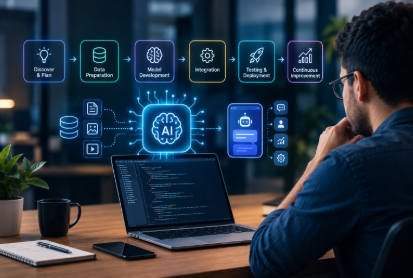
Software modernization is no longer limited to migrating legacy applications to the cloud or replacing outdated technology stacks. Businesses are increasingly using artificial intelligence to analyze legacy code, automate testing, improve application architecture, modernize workflows, and introduce intelligent capabilities into existing software.
AI can also help organizations understand complex codebases, identify technical debt, generate documentation, improve development workflows, and build intelligent agents around existing business processes. Current modernization approaches increasingly combine cloud transformation, AI-assisted development, automation, and application re-engineering rather than relying on a simple lift-and-shift strategy.
Choosing the right AI software development company therefore requires more than looking for a conventional modernization vendor. Businesses should evaluate AI expertise, software engineering capabilities, cloud experience, security practices, integration capabilities, and the ability to modernize without disrupting existing operations.
Here are 10 companies worth considering for AI-driven software modernization in 2026.
Table of Contents
1. Octal IT Solution
Octal IT Solution is a software development and technology services company that can be considered for businesses looking to modernize existing applications with AI, cloud technologies, and contemporary development frameworks.
Its modernization approach can include assessing existing software architecture, improving application performance, upgrading outdated technology stacks, integrating AI capabilities, and developing new intelligent functionality around established systems.
For organizations looking to move beyond basic modernization, AI can be introduced into existing applications through intelligent automation, recommendation systems, conversational interfaces, predictive capabilities, and AI-powered workflows. Organizations can also hire AI developers to build and integrate customized AI functionality according to their software requirements.
Octal can also support businesses exploring AI-agent use cases where autonomous or semi-autonomous systems can perform specific business tasks, interact with application data, or automate repetitive workflows.
Best for: Custom software modernization, AI integration, application redevelopment, and AI-enabled digital products.
Relevant capabilities: AI development, application modernization, cloud development, mobile and web development, AI integration, and AI agent development.
2. Accenture
Accenture is a strong option for enterprises undertaking large-scale application modernization programs. Its modernization practice focuses on assessing application portfolios, defining target architectures, planning modernization journeys, and transforming legacy applications.
The company combines cloud transformation, application engineering, automation, and generative AI to help organizations address technical debt and create more adaptable software environments.
Its scale makes it particularly relevant for enterprises modernizing multiple applications, business units, or technology environments simultaneously.
Best for: Large-scale enterprise application transformation and modernization.
3. IBM
IBM is particularly relevant for organizations dealing with complex enterprise and mainframe environments. Its AI and modernization capabilities combine IBM Consulting with technologies designed to help organizations analyze, transform, and modernize legacy applications.
IBM is also positioned strongly for organizations that need to modernize systems while preserving established business logic and enterprise processes.
Best for: Mainframe modernization, enterprise applications, hybrid cloud, and AI-assisted modernization.
4. Infosys
Infosys has developed an AI-first approach to application modernization through its modernization and cloud capabilities. Its modernization services cover legacy applications, cloud migration, open-source adoption, and mainframe transformation.
The company has also introduced an AI-driven modernization solution combining Infosys ILEAD, Pega Blueprint, and Amazon Bedrock to support application transformation and business-process reimagination.
This makes Infosys a relevant choice for enterprises that want to combine application modernization with broader AI adoption.
Best for: Enterprise modernization, cloud transformation, and AI-led application transformation.
5. TCS
Tata Consultancy Services is one of the largest global technology services companies and has extensive experience modernizing enterprise software environments.
Its modernization capabilities span cloud migration, application transformation, automation, data modernization, and AI-enabled software engineering.
TCS is particularly suitable for organizations with large technology estates where modernization needs to happen across multiple applications and business functions.
Best for: Large enterprise portfolios, legacy transformation, cloud modernization, and managed modernization programs.
6. HCLTech
HCLTech is another major enterprise technology provider with capabilities across application modernization, cloud transformation, engineering, and AI.
Its modernization work is relevant for businesses dealing with complex legacy environments, including applications that require significant re-engineering rather than straightforward migration.
HCLTech has also been highlighted among leading legacy-modernization providers in current industry coverage, particularly for modernization of complex enterprise and embedded technology environments.
Best for: Complex legacy environments, enterprise engineering, and large modernization programs.
7. Capgemini
Capgemini provides application modernization services covering legacy transformation, cloud, data, automation, and AI.
The company’s positioning is particularly relevant for enterprises that need to modernize established applications while connecting the transformation with broader digital and business initiatives.
Capgemini is also among the major providers identified in AI-services market assessments and legacy application modernization research.
Best for: Enterprise application modernization, cloud transformation, and AI-enabled digital transformation.
8. Cognizant
Cognizant combines software engineering, cloud, data, automation, and AI capabilities for organizations modernizing legacy technology.
Its experience across industries can be useful where modernization involves not only technology upgrades but also changes to business workflows and customer-facing applications.
Cognizant is consistently included among major providers in legacy application modernization research, particularly for complex enterprise environments.
Best for: Industry-specific modernization, enterprise applications, and AI-enabled transformation.
9. Wipro
Wipro offers application modernization, cloud transformation, AI, automation, and engineering services for enterprises with complex technology environments.
Its modernization capabilities are relevant for organizations seeking to update legacy systems while introducing more automated and intelligent development and operational processes.
Wipro’s recent AI strategy also demonstrates its growing focus on integrating AI into enterprise operations and software delivery.
Best for: Enterprise modernization, cloud transformation, AI adoption, and large-scale technology programs.
10. EPAM Systems
EPAM is known for digital engineering and software product development, making it a relevant option for organizations modernizing established software products and complex technology platforms.
Its strengths include cloud engineering, application transformation, data, AI, and software engineering. This combination can be useful when modernization requires substantial re-engineering rather than simply migrating an existing application.
EPAM is also identified among notable modernization providers in current industry comparisons.
Best for: Digital product modernization, complex software engineering, cloud transformation, and AI-enabled development.
How to Choose an AI Development Company for Software Modernization
The right modernization partner depends on the condition of the existing application, business objectives, technology stack, and the level of AI transformation required.
Before selecting a vendor, evaluate these areas:
1. Legacy Code Assessment
The provider should be able to understand the existing codebase, architecture, dependencies, databases, APIs, and business logic before recommending a modernization strategy.
2. AI-Assisted Modernization
Look for experience using AI to accelerate code analysis, documentation, testing, refactoring, migration, and software development. AI should support engineering teams rather than simply be added as a marketing feature.
3. Cloud and Architecture Expertise
Modernization frequently involves moving from monolithic or outdated architectures toward cloud-native, modular, API-driven, or microservices-based environments.
4. AI Integration
A strong modernization partner should be able to integrate AI into existing applications instead of requiring businesses to replace the entire product.
This may include generative AI, machine learning, intelligent search, recommendation engines, conversational interfaces, predictive analytics, or workflow automation.
5. AI Agent Capabilities
For businesses looking to automate multi-step workflows, evaluate whether the provider offers AI agent development services.
AI agents can potentially interact with enterprise systems, retrieve information, execute defined tasks, and automate workflows while operating within appropriate security and governance controls.
6. Security and Compliance
Modernization should not create new security risks. Evaluate the provider’s approach to data protection, access controls, secure APIs, AI governance, testing, and regulatory requirements.
7. Post-Modernization Support
Software modernization is an ongoing process. Choose a partner capable of providing maintenance, optimization, feature development, cloud management, and continued AI integration after the initial transformation.
Final Thoughts
AI is changing how organizations approach software modernization. Instead of simply replacing old technology, businesses can use AI to understand legacy systems, accelerate development, automate testing, improve workflows, and introduce intelligent capabilities into established applications.
The best partner will depend on the complexity of the existing software, modernization objectives, budget, technology stack, and desired AI capabilities.
For businesses seeking a flexible technology partner, an AI software development company can help combine application modernization with new AI capabilities. Organizations can also hire AI developers to build specialized AI functionality or work with a dedicated engineering team to modernize and extend an existing product.
For more advanced automation requirements, evaluating providers with AI agent development services can help businesses explore intelligent workflows that operate across applications, data sources, and business processes.

