
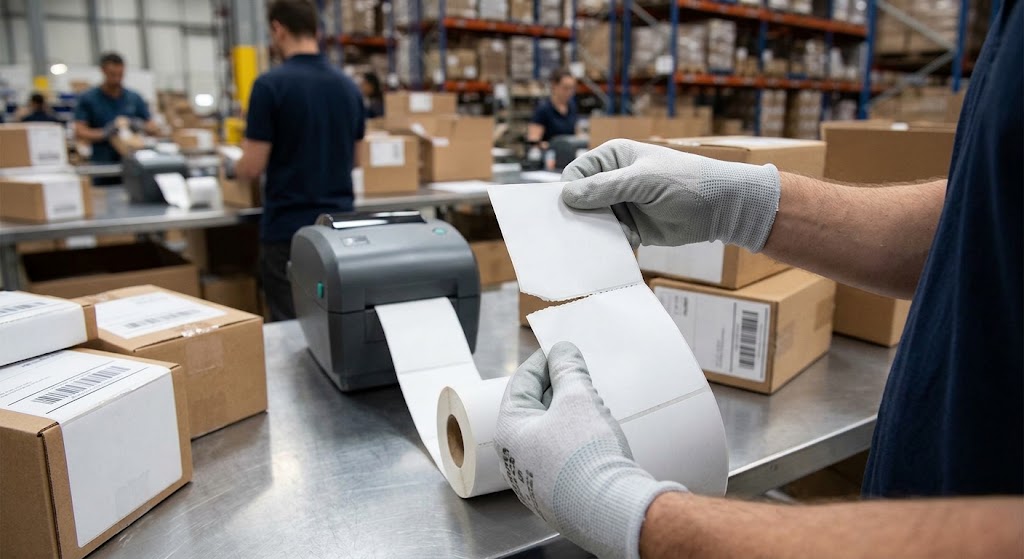
Perforations make it easier to separate individual labels or sections of liner, but they also introduce a controlled weak point. Their value depends on whether operators hand out labels, retain records, use peel edges, or feed the web through printers, rewinders, and applicators that need continuous liner strength.
For operations choosing between perforated and nonperforated label rolls, the decision depends first on where perforations help and where liner strength matters. The approved item record should preserve the conditions and test results that support the choice.
When reviewing how do perforations affect thermal label handling and productivity, buyers can compare relevant perforated labels before requesting samples. Product listings help narrow the options, but approval should use the actual printer, surface, and operating environment described in this article.
Table of Contents
Where Perforations Help
A perforation between labels lets an operator detach a printed label with its liner for later application or distribution. It can also separate batches without scissors.
Observe the actual task and count how often labels need to leave the printer before peeling. If every label is applied immediately, perforations may provide little benefit.
A production trial should include normal variation in where perforations help, including different operators or package lots when those factors change the process.
Where Liner Strength Matters
Printers and applicators pull the liner through guides and around rollers. A weak or damaged perforation can tear under tension and stop the process.
Test at the highest web tension and speed used in production. Include rewinding or peeling equipment rather than testing only a desktop printer.
The purchase specification should state the accepted condition for where liner strength matters so a repeat order can be checked against the same requirement.
How Perforation Quality Varies
Cut length, tie length, liner thickness, and alignment determine how easily the web tears. A perforation that is too strong frustrates operators, while one that is too weak separates inside the printer.
Set an acceptable hand-tear behavior and machine-run result. Inspect several positions across the roll and from different production lots.
If results differ, change one factor at a time. This separates the effect of how perforation quality varies from printer maintenance, artwork, or handling changes.
How Location Affects Sensors
Perforations can alter the light or reflectance seen by a sensor, especially with unusual gaps, holes, or thin liners. They may also collect dust at repeated positions.
Confirm the sensor path and calibrate with the final perforated construction. Watch for skips that repeat at the perforation interval.
Keep a retained sample that demonstrates acceptable how location affects sensors. Written descriptions alone may not capture the physical behavior that matters in this application.
How Perforations Change Waste
Easy separation can reduce accidental extra labels, but torn liner fragments may add housekeeping work. Operators may also discard the first label after an uncontrolled break.
Measure labels used per completed task, unplanned tears, cleanup, and restart waste. Compare the full shift rather than a few convenient hand tears.
For operations choosing between perforated and nonperforated label rolls, the relevant result is whether how perforations change waste remains consistent during normal work, not whether one carefully prepared sample looks acceptable.
What to Include in the Order
The order should state whether perforations are required, where they sit, and how they must perform. Simply describing a roll as perforated leaves strength and placement undefined.
Provide a retained sample and dimensioned repeat. Approve the perforation together with the facestock, adhesive, liner, core, and winding direction.
Record the media lot, printer, surface, environment, and observation when checking what to include in the order. These details make later comparisons useful.
Buyer Checklist
- Where Perforations Help Observe the actual task and count how often labels need to leave the printer before peeling.
- Where Liner Strength Matters Test at the highest web tension and speed used in production.
- How Perforation Quality Varies Set an acceptable hand-tear behavior and machine-run result.
- How Location Affects Sensors Confirm the sensor path and calibrate with the final perforated construction.
- How Perforations Change Waste Measure labels used per completed task, unplanned tears, cleanup, and restart waste.
A supplier discussion should use the completed specification rather than the article title alone. Buyers evaluating how do perforations affect thermal label handling and productivity can ask BETCKEY labels to confirm the available construction and sample details. Any performance claim should be checked against the intended printer, substrate, temperature, handling, and service period.
Common Buyer Questions
What is the main check for where perforations help? A perforation between labels lets an operator detach a printed label with its liner for later application or distribution. It can also separate batches without scissors. Observe the actual task and count how often labels need to leave the printer before peeling. If every label is applied immediately, perforations may provide little benefit.
What is the main check for where liner strength matters? Printers and applicators pull the liner through guides and around rollers. A weak or damaged perforation can tear under tension and stop the process. Test at the highest web tension and speed used in production. Include rewinding or peeling equipment rather than testing only a desktop printer.
What is the main check for how perforation quality varies? Cut length, tie length, liner thickness, and alignment determine how easily the web tears. A perforation that is too strong frustrates operators, while one that is too weak separates inside the printer. Set an acceptable hand-tear behavior and machine-run result. Inspect several positions across the roll and from different production lots.
Final Buying Decision
Base the final choice on measured results for where perforations help, where liner strength matters, and what to include in the order. Approve the complete label construction with a written test method and retained sample. Operators then have a stable setup, and purchasing can compare quality, price, and supply against the same requirement.
Production Approval
Run the proposed item through a representative production period before full deployment. For operations choosing between perforated and nonperforated label rolls, the trial should include the busiest normal condition, the most difficult surface or package, and the printer with the least performance margin. Count feeding errors, reprints, application failures, unreadable text, and rescans. Review the evidence with operations and purchasing, update the item specification, and retain the final sample with its lot number.

