
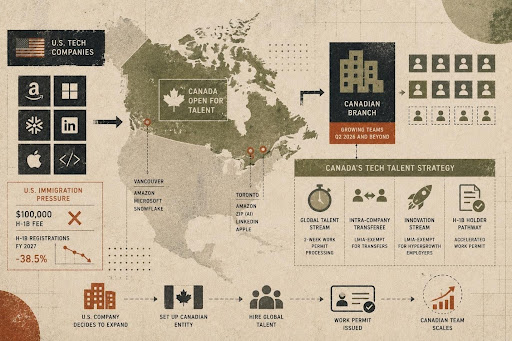
On Nov. 25, 2025, San Francisco-based AI procurement company Zip opened a new Toronto headquarters four times the size of its previous Canadian office, with plans to nearly triple its local workforce by early 2026.
Zip is the latest visible signal of a pattern My Visa Source has been watching build over the past 18 months. U.S. technology companies, startups and giants alike, are quietly opening or expanding Canadian branches, often without the press splash that used to accompany corporate cross-border moves.
Table of Contents
The pattern Canadian immigration lawyers are seeing
Amazon’s downtown tech hubs in Vancouver and Toronto now house more than 8,500 corporate and technology employees, split between 4,500 at The Post in Vancouver and 3,500 at the Toronto Tech Hub. Microsoft maintains a major Vancouver development hub. Snowflake, LinkedIn, and Apple all operate Canadian offices near Zip’s new home in downtown Toronto.
These giants have been investing in Canada for a decade. The shift over the past year is in the size and speed of new entrants: mid-market SaaS companies, AI startups, and series-B firms that wouldn’t have considered a Canadian footprint two years ago. My Visa Source is now fielding inquiries from U.S. companies who, on a Friday call, mention they want a Canadian office operational by Q2.
The reason most often cited in those conversations: the U.S. immigration environment for skilled foreign workers has become economically untenable.
The driver: a $100,000 fee and a shrinking H-1B lottery
On Sept. 19, 2025, U.S. President Donald Trump signed a proclamation imposing a $100,000 fee on new H-1B visa petitions, a move thought to mainly affect the U.S. technology industry, which has long depended on H-1B holders for its specialized workforce. Combined with a new wage-weighted selection rule from the Department of Homeland Security, the change reshaped the lottery. H-1B registrations fell 38.5% for FY 2027, dropping to 211,600 from 343,981 the year prior. Employers concluded the math doesn’t work, particularly startups and small businesses.
For a company with a 100-person engineering organization, an H-1B-heavy hiring strategy now carries a cost burden that flows straight through to runway. The companies My Visa Source advises tend to model this out within hours of the proclamation. What they conclude, almost uniformly, is that the U.S. isn’t the most efficient venue for hiring the foreign engineering talent they need, and Canada’s sitting right there, with infrastructure built specifically for this scenario.
Canadian Prime Minister Mark Carney made the country’s position explicit at a Sept. 27, 2025 press conference in the United Kingdom. “What is clear is the opportunity to attract people who previously would have got so-called H-1B visas,” Carney said. “Not as many people are going to get visas to the United States. And these are people with lots of skills, enterprising, and willing to move to work.”
Five days earlier, a Council on Foreign Relations audience in New York had been told by Carney: “I understand you’re changing your visa policy. Maybe we can hang on to one or two of them.”
The choice of words was deliberate. This corridor has been quietly built since 2023.
What Canada’s Tech Talent Strategy offers
Canada’s Tech Talent Strategy, announced in June 2023, was designed for exactly the conditions that now exist. It provides several work permit pathways that U.S. tech companies use, based on their structure and hiring needs:
- The Global Talent Stream processes work permit applications for high-skilled foreign workers in select IT occupations on a two-week standard. For most IT roles, it bypasses the Labour Market Impact Assessment requirement that slows traditional Canadian work permits.
- The Intra-Company Transferee program is the workhorse for U.S. companies with a Canadian entity. It allows a multinational employer to transfer executives, senior managers, or specialized-knowledge employees from a U.S. office to a Canadian office. The program is LMIA-exempt, which means the employer doesn’t need to first demonstrate the absence of qualified Canadian candidates.
- The Innovation Stream is a newer LMIA-exempt pathway introduced in September 2024 under the broader Tech Talent Strategy, available to employers participating in the Global Hypergrowth Project.
- The work permit pathway for H-1B holders was opened on July 16, 2023 with a 10,000-application cap. It filled in less than 48 hours. IRCC has signalled plans to re-open the accelerated work permit pathway as part of its renewed talent strategy.
For U.S. employers with a Canadian entity, the practical effect is that a foreign engineer who would otherwise face the H-1B lottery, and now a $100,000 fee on top of it, can instead be transferred to the Canadian office under intra-company rules. A work permit is issued in a fraction of the time and at a fraction of the cost. The same employee can then be re-registered in the annual U.S. H-1B lottery while they work in Canada, ready to be brought back south if and when a number eventually comes through.
That’s the structure. The question for most U.S. companies My Visa Source advises is how to open a Canadian branch in the first place.
The mechanics of opening a Canadian branch
The decision tree is more complex than most U.S. founders expect. Three main paths are typically on the table:
- Federal incorporation of a Canadian subsidiary. The most common route for established U.S. companies. A wholly-owned Canadian subsidiary is registered federally or in a specific province, gets its own Canadian tax ID, and becomes the legal employer for Canadian workers. The U.S. parent and Canadian subsidiary qualify as a “multinational” for Intra-Company Transferee purposes from day one.
- Extra-provincial registration. A simpler structure, suitable for companies whose Canadian operations will be small. The U.S. company itself registers to do business in a Canadian province without forming a separate legal entity. It’s faster to set up but creates more complex tax exposure and limits some immigration program eligibility.
- An employer of record (EOR) arrangement. Useful for companies that want to hire a small number of Canadian employees without setting up infrastructure. The EOR becomes the legal employer; the U.S. company directs the work. This is the fastest option but doesn’t establish a “Canadian office” for Intra-Company Transferee purposes.
The path that fits depends on the company’s headcount plans, tax structure, growth horizon, and what it wants to do with foreign engineering hires currently sitting on H-1B status or stuck in F-1 OPT. My Visa Source’s most common observation is that U.S. companies underestimate the legal complexity of cross-border hiring and overestimate the difficulty of opening a Canadian entity. The first is harder than they think. The second is easier.
A typical sequence My Visa Source walks U.S. clients through: a Canadian subsidiary is incorporated, three to five immediate hires are identified (typically a mix of Canadian residents and U.S.-based foreign workers under intra-company transfer), work permits are filed in parallel, and a functional Canadian engineering team is in place within 60 to 90 days. The timeline is tight but realistic with experienced counsel on both sides of the border.
What the quiet pattern tells us
The most striking feature of this trend is how little of it’s making headlines. Most Canadian branches aren’t announced the way they would’ve been a decade ago. There’s no ribbon-cutting, no LinkedIn post from the CEO, no press release with photos of the local mayor.
Part of the reason is political: a U.S. company that publicly announces it is hiring in Canada because of U.S. immigration policy invites political and reputational risk in its home market. Part of it is competitive: companies that have figured out the structure prefer to operate it quietly while H-1B costs continue to be absorbed by competitors. Part of it is simply that the move is becoming standard, and standard moves don’t generate press.
For U.S. business leadership, the cross-border hiring infrastructure is now embedded in the technology sector’s operating reality. Whether a given company chooses to use it is a strategic question. The Canadian option has moved from curiosity to standard practice. For a sizable share of U.S. technology employers, it’s the primary path forward for foreign talent acquisition.
My Visa Source’s working observation is that the companies handling this best are the ones that started planning before they had to. The companies pivoting under pressure (after an H-1B denial, after a fee shock, after losing a critical engineering hire to a competitor that already moved) tend to take longer to get operational and absorb more legal and tax friction along the way.
My Visa Source closely monitors immigration policy developments in Canada and the United States.

