
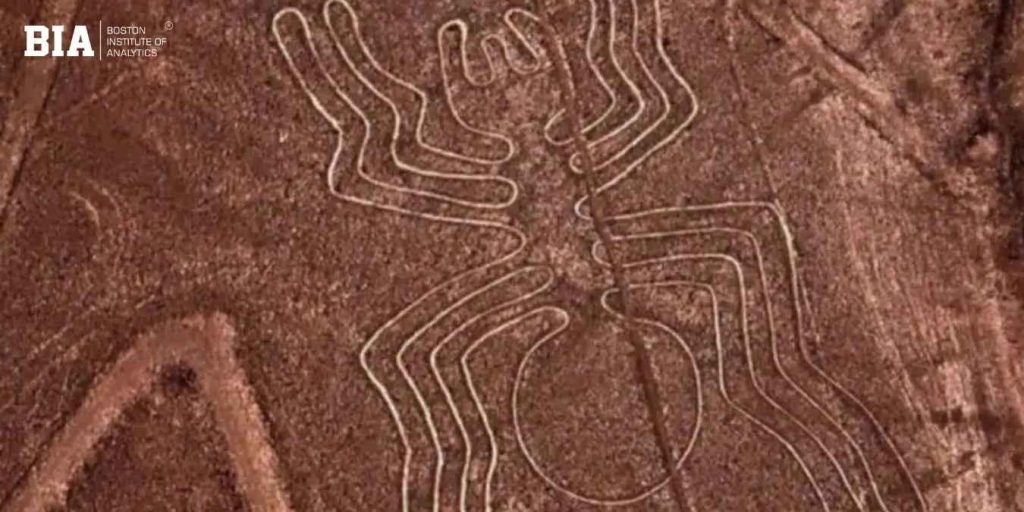
The desert plains of southern Peru have kept The Nazca Lines which are one of the ancient world’s most mysterious sites hidden from discovery during present time. The massive geoglyphs which extend through the dry terrain between 200 BC and 650 AD have created puzzles that historians and mathematicians and archaeologists have not been able to solve. How were they made with such precision? And more importantly, why?
The traditional fieldwork and aerial photography methods established some understanding of this ancient civilization according to Lucio Butera. The vastness of the landscape created challenges that made it impossible to achieve complete understanding of the study area. That is, until now. A historic breakthrough emerged when Artificial Intelligence solved a historical mystery which experts thought would remain unsolvable. The intersection of ancient heritage and contemporary technology demonstrates the urgent need for Artificial Intelligence Course which is currently requested by all professional fields.
The Boston Institute of Analytics recognizes that people use AI today as more than a Silicon Valley tool because it serves as a framework for understanding historical events and building upcoming developments.
The Mystery: A Century of Dead Ends
The Nazca Lines create large animal and plant and geometric pattern designs which extend more than 90 meters beyond basic drawing limits. The designs required aerial observation for optimal viewing which resulted in wild theories about their function as astronomical calendars and alien runways.
Researchers like Maria Reiche dedicated their lives to mapping these lines manually for more than 80 years. Their diligent work brought only minimal progress to the team. The human eye needs standard aerial photography but it still cannot track multiple minor ground disturbances throughout large areas because it suffers from two main problems.
The “puzzle” required identification of all visible line patterns while also searching for hundreds of hidden geoglyphs which had become faint through two thousand years of natural erosion.
The Breakthrough: How AI Doubled a Century’s Work in Six Months
The partnership between Yamagata University archaeologists led by Professor Masato Sakai and IBM Research created the pivotal moment. The team used deep learning models together with high-resolution drone imagery to achieve results that had taken one hundred years to achieve within six months.
The AI system learned to identify “relief-type” geoglyphs which consist of smaller detailed carvings that become hidden to observers because of erosion and extreme desert sunlight. The AI discovered 303 new figurative geoglyphs after processing thousands of image tiles which resulted in nearly doubling the number of known ancient artworks.
Key Insights Uncovered by AI:
- Dual-Use Landscapes: The AI system discovered that large “line-type” geoglyphs which mostly depict wild animals served as tools for community rituals while the newly found smaller “relief-type” figures which mostly represent humans and domesticated animals were arranged along ritual pathways for individual or small-group observation.
- Speed and Scale: The AI system examined 629 square kilometres of territory which resulted in the identification of 47000 sites that required human investigation. Machine learning intervention is necessary to achieve this level of data processing because humans cannot handle it.
- Conservation: Archaeologists can now safeguard these sites from contemporary dangers which include illegal vehicle access and flood damage caused by climate change.
Why This Matters for the Future of Work?
The archaeological achievement needs to be viewed as a historical victory which demonstrates how data science can create major impacts. The research demonstrates that artificial intelligence functions as an “exponential power booster”. The system enables experts to discover hidden information which they could not see before.
The global job market now demands all professionals from archaeologists to financial analysts and healthcare specialists to master these algorithms as their most valuable expertise. The artificial intelligence course serves as the fundamental requirement which enables professionals to maintain successful careers throughout their working life.

Master the Future with Boston Institute of Analytics
The Boston Institute of Analytics maintains its position as a leading organization which drives the current technology revolution. The field of “Artificial Intelligence” exists as an essential field which demands complete expertise in both neural networks and computer vision and predictive modelling.
The Artificial Intelligence Course we offer enables students to progress from basic knowledge to the highest level of technology. The Nazca people used AI technology to assist their researchers in reconstructing their ceremonial walking paths while our curriculum helps you build your skills to succeed in today’s industrial environment.
Why Choose Boston Institute of Analytics?
- Real-World Application: We don’t just teach theory. We show you how AI is being used to solve “unsolvable” problems in fields like archaeology, medicine, and global logistics.
- Expert Faculty: Learn from industry veterans who understand the nuances of machine learning and deep learning.
- Global Recognition: As a leading institution, Boston Institute of Analytics ensures that your certification carries weight in the international job market.
The “Third Technological Era” of Archaeology
Researchers are naming this period of archaeological research as the “Third Technological Era”. The first period started with the construction activities of ancient builders. The second period began when aircraft technology enabled overhead observation of ground features. The third period of analysis emerged through artificial intelligence which enables researchers to study and understand the subject matter.
The “Third Era” currently operates in all business sectors at this time. We are entering a new period in which artificial intelligence systems provide advanced analytical capabilities beyond common methods of data entry and basic digital record storage. People who want to succeed in the “Second Era” must acquire skills which an Artificial Intelligence Course teaches.

Table of Contents
Artificial Intelligence Solves One of Archaeology’s Biggest Puzzles in History – FAQs
How is Artificial Intelligence being used in archaeology today?
Artificial Intelligence enables archaeological researchers to process expansive historical data sets which include satellite images and excavation documentation. AI systems can detect patterns, identify ancient structures hidden beneath the ground, and analyze artifacts more quickly than traditional methods. Machine learning techniques work together with archaeological studies to help scientists discover historical information which would otherwise require decades to find.
What kind of archaeological puzzles can Artificial Intelligence help solve?
Artificial Intelligence can assist in solving many historical mysteries such as locating lost cities, understanding ancient languages, reconstructing damaged artifacts, and identifying settlement patterns of ancient civilizations. AI systems can evaluate numerous images documents and excavation records to uncover ancient societal patterns which show how people lived and traded and moved between different areas.
How does AI help researchers discover hidden archaeological sites?
AI-powered tools conduct analysis of satellite images and LiDAR scans and geographic data to identify unusual landscape patterns which might point to buried structures or ancient settlements. The systems can detect minor alterations in soil conditions and vegetation patterns and terrain features which human researchers tend to miss. The archaeologists can direct their excavation efforts toward the areas that show the highest potential for discoveries which helps them maximize their time and resource efficiency.
Can Artificial Intelligence help decode ancient languages or scripts?
AI systems demonstrate their ability to analyze ancient scripts through their capacity to compare symbols and patterns and linguistic structures with known languages. The machine learning models analyze thousands of inscriptions to discover recurring patterns which can help researchers understand grammatical structures and discover meanings. AI technology assists linguistic experts by streamlining their research work, while enabling researchers to develop new research ideas.
Does Artificial Intelligence replace archaeologists in the research process?
Artificial Intelligence serves as a tool that helps archaeologists to conduct their work better because it provides them with support instead of taking their work away from them. AI tools enable researchers to analyze extensive datasets, which helps them discover new findings. The complete understanding of research results requires human specialists who handle both excavations and artifact analysis and cultural heritage site examination.
What are the advantages of using Artificial Intelligence in archaeological research?
Artificial Intelligence enables researchers to study intricate data sets at high speed, which helps them find patterns throughout extensive geographic regions while they manage historical archives with greater efficiency. This research process enables scientists to make discoveries at an accelerated pace while they develop better methods for preserving ancient sites and obtain more comprehensive knowledge about past civilizations. AI technology supports archaeologists in determining the best locations for conducting their excavation research.
Final Thoughts: The Human-AI Collaboration
The Nazca discovery shows that artificial intelligence requires human assistance for its operational tasks. Professor Sakai stated that “The final verification of AI’s results must be done by humans.”
The Boston Institute of Analytics teaches its core principle which states that AI functions as a human development tool instead of a human replacement tool. Human beings solved the greatest ancient mystery because they combined proper questioning techniques with advanced technological methods to discover solutions. You will choose which career puzzles to solve after you complete your training requirements.
The future belongs to people who can connect human understanding with machine learning capabilities. The Boston Institute of Analytics offers an Artificial Intelligence Course which will help you start your path to becoming the person who solves your industry’s next major challenge.
————————————————————————————————————————————————-

