
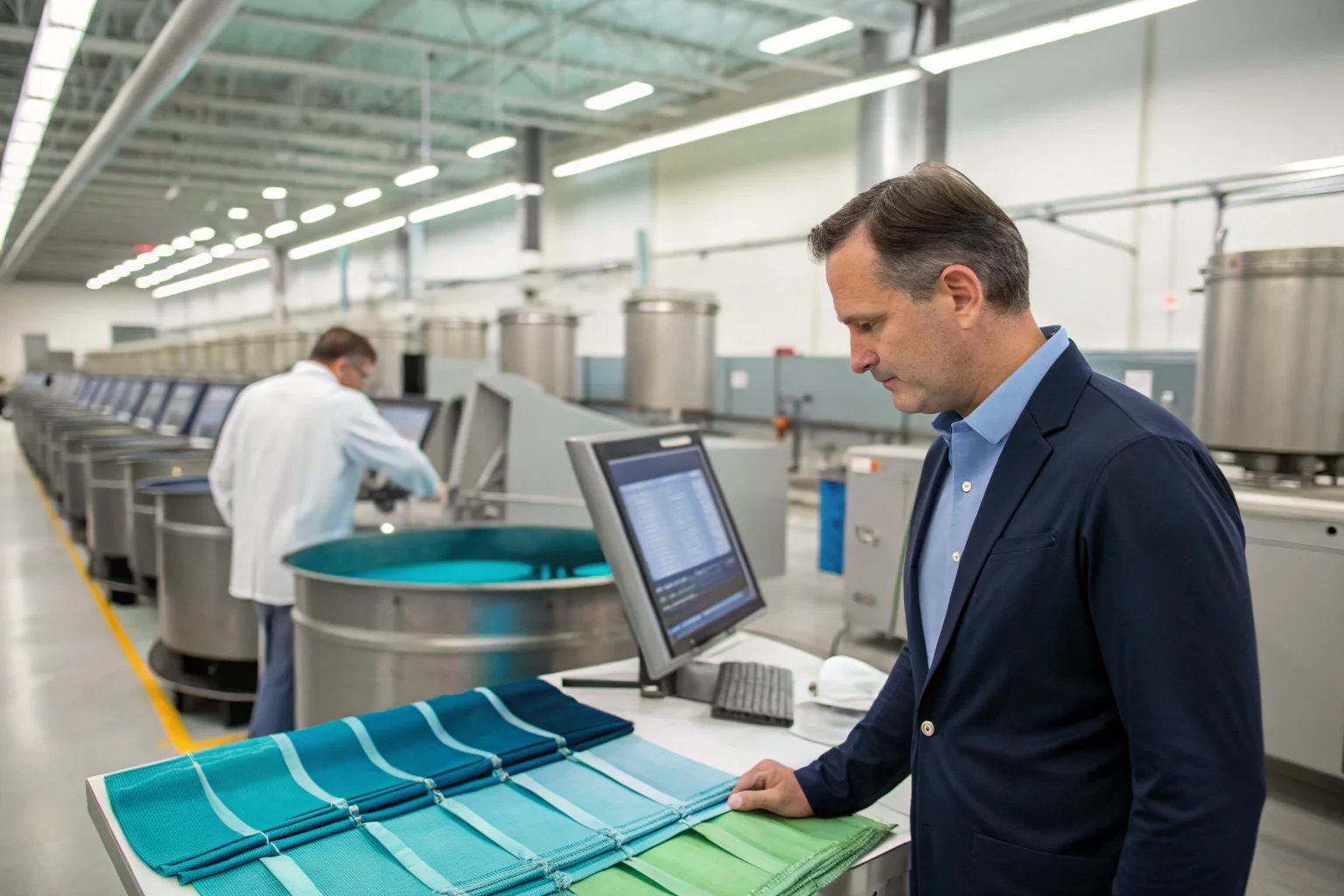
Color accuracy and design consistency are two of the most sensitive aspects of product quality in industries such as textiles, packaging, plastics, printing, FMCG, flooring, automotive interiors, ceramics, and consumer goods. Even a small deviation in shade or pattern—often invisible to the human eye in real-time production—can lead to batch rejection, customer complaints, warranty issues, and heavy rework losses.
To overcome these challenges, manufacturers are increasingly relying on AI-powered color shade inspection and design matching systems, which combine high-resolution industrial cameras, controlled lighting, and advanced color science to ensure every product matches the master design with scientific accuracy.
Intelgic is one of the leading innovators in this domain, offering a comprehensive, production-ready solution that detects shade variations, design mismatches, and print deviations using CIELAB and LCh 3D color spaces—the gold standard in global color quality control.
Table of Contents
Why Color Shade Inspection Matters
Color quality is not just an aesthetic characteristic; it has engineering, branding, and Ffunctional implications.
1. Customer Perception & Brand Consistency
Consumers expect a consistent shade across products—even slight variations can reduce perceived quality.
2. Material & Process Variations
Changes in substrates (paper, plastic, metal, textile), ink types, dye batches, coating thickness, or environmental conditions cause unpredictable shade shifts.
3. High-Speed Manufacturing
In fast production lines, human inspectors cannot quantify subtle color differences reliably.
4. Traceability & Compliance Requirements
Industries now require documented, repeatable color measurements and digital proof of quality.
Understanding Color Measurement: Why Human Vision Isn’t Enough
Basic color spaces like RGB or CMYK are device-dependent, meaning they change with camera sensors, lighting, and monitors.
Industrial inspection must be based on device-independent scientific color models—this is where CIELAB and LCh come in.
CIELAB (L*a*b*)
A perceptually uniform 3D color model used globally for measuring color difference.
- L* → lightness
- a* → green–red axis
- b* → blue–yellow axis
LCh
A polar representation of Lab for improved visual analysis:
- L → lightness
- C → chroma (color intensity)
- h → hue (actual color type)
These models allow manufacturers to compare any product’s shade to a reference with scientific precision.
The ΔE Formula: Quantifying Color Difference
Color mismatch is calculated using ΔE, a single numeric value that indicates how different two colors are.
Common versions include:
- ΔE76 (basic difference)
- ΔE94 (improved uniformity)
- ΔE2000 (most accurate; used in Intelgic systems)
Typical industrial tolerances:
| Application | Acceptable ΔE Value |
| Luxury textiles | < 0.8 |
| High-end printing | < 1.0 |
| Packaging & labels | < 1.5 |
| Plastics & molded parts | < 2.0 |
| Ceramics / flooring | < 2.0–3.0 |
Intelgic’s solution automatically compares every zone, every product, and every batch to ensure ΔE stays within allowed limits—non-contact, real-time, and 100% inspection.
Design Matching: Beyond Color
Modern products have complex design elements—logos, motifs, patterns, barcodes, QR codes, gradients, stripes, textures, micro-prints, and multi-color graphics.
Defects often include:
- Misalignment
- Scaling or stretching
- Missing portions
- Registration errors
- Logo distortions
- Pixel-level shifts
- Banding or streaking
- Uneven ink deposition
Intelgic’s system performs pixel-level geometry matching, cross-checking the printed or applied design against a master template or vector file.
Intelgic’s Color Shade & Design Matching Solution
Intelgic offers a holistic system designed specifically for industrial environments where lighting, vibration, and substrate variations make accurate color inspection extremely challenging.
1. High-Resolution Industrial Cameras
Custom-selected area or line-scan cameras capture ultra-clear images of printed surfaces, textiles, films, plastics, and coated metal sheets.
2. Controlled Lighting Environment
Uniform lighting eliminates shadows and color shifts. Intelgic supports:
- D50/D65 color-grade illuminators
- Diffused dome lights
- Coaxial lighting for glossy surfaces
- Multi-angle LED arrays for texture detection
3. 3D Color Space Analysis (CIELAB, LCh)
Intelgic’s software converts every image into CIELAB/LCh, enabling:
- Region-wise color measurement
- ΔE evaluation
- Shade uniformity analysis
- Highlight/shadow compensation
4. Design Geometry Matching
The AI engine aligns the captured image with the master image and evaluates:
- Shape deformation
- Logo mismatch
- Print mis-registration
- Distorted or missing elements
5. Automatic Print File Generation for Different Materials
One of Intelgic’s unique capabilities is generating an accurate print file for:
- Different printing substrates (textile, plastic, metal, ceramic, wood)
- Color raw materials (inks, dyes, pigments)
- Manufacturing process variations
This ensures the final printed output matches the intended design across varying materials.
6. Real-Time Inspection & Pass/Fail Decisioning
Each product is evaluated in milliseconds, offering:
- Pass/Fail decision
- Zone-wise defect map
- ΔE heatmap
- Design mismatch markers
7. Digital Quality Certificate & Traceability
Every inspected job generates:
- Image evidence
- ΔE reports
- Design deviation logs
- Operator & machine timestamps
Perfect for audits and customer compliance.
Where is the Technology Used?
- Textiles & Fabrics: Shade matching across rolls, batches, and lots.
- Packaging & Label Printing: Logo alignment, color consistency, print accuracy.
- Plastic Molding & Injection Parts: Shade variation detection across molded components.
- Ceramic Tiles & Flooring: Pattern alignment, texture matching, color uniformity.
- Paper & Film Printing: Flexo, offset, digital printing shade control.
- Automotive Interiors: Matching trims, panels, leather and plastic textures.
Benefits for Manufacturers
1. Zero Guesswork Color Control
Scientific color measurement replaces subjective human evaluation.
2. Lower Cost of Rework & Rejection
Real-time detection prevents large batch failures.
3. Brand Consistency Across Factories
CIELAB/LCh-based measurement ensures uniformity worldwide.
4. Digital Traceability
Automatic records support QA audits and complaint resolution.
5. Adaptable to Any Material or Design
Paper, textile, plastic, metal, ceramic—Intelgic handles all.
Color shade variation and design mismatches significantly impact product quality and brand reputation. Traditional manual inspection is unreliable, inconsistent, and impossible to scale for modern high-speed production lines.
Intelgic’s advanced AI-powered Color Shade & Design Matching Solution, built on CIELAB/LCh 3D color science, industrial-grade imaging, and intelligent software, ensures manufacturers achieve zero-defect color accuracy, perfect design alignment, and full production traceability—across any material, printer, or production process.
This is the future of color quality control: scientific, automated, and uncompromisingly precise.

