

Financial markets have become increasingly complex and fast-paced, creating challenges for traders trying to stay ahead of market movements. Artificial intelligence has emerged as a game-changing solution, offering sophisticated tools that can process vast amounts of market data, identify trading opportunities, and execute strategies with precision that surpasses human capabilities. These AI-powered platforms function as intelligent trading assistants, helping traders analyze market trends, make data-driven decisions, and execute trades with enhanced speed and accuracy.
Table of Contents
Top AI Trading Platforms for 2025
1. TradeEasy.ai – Next-Generation Market Intelligence Platform
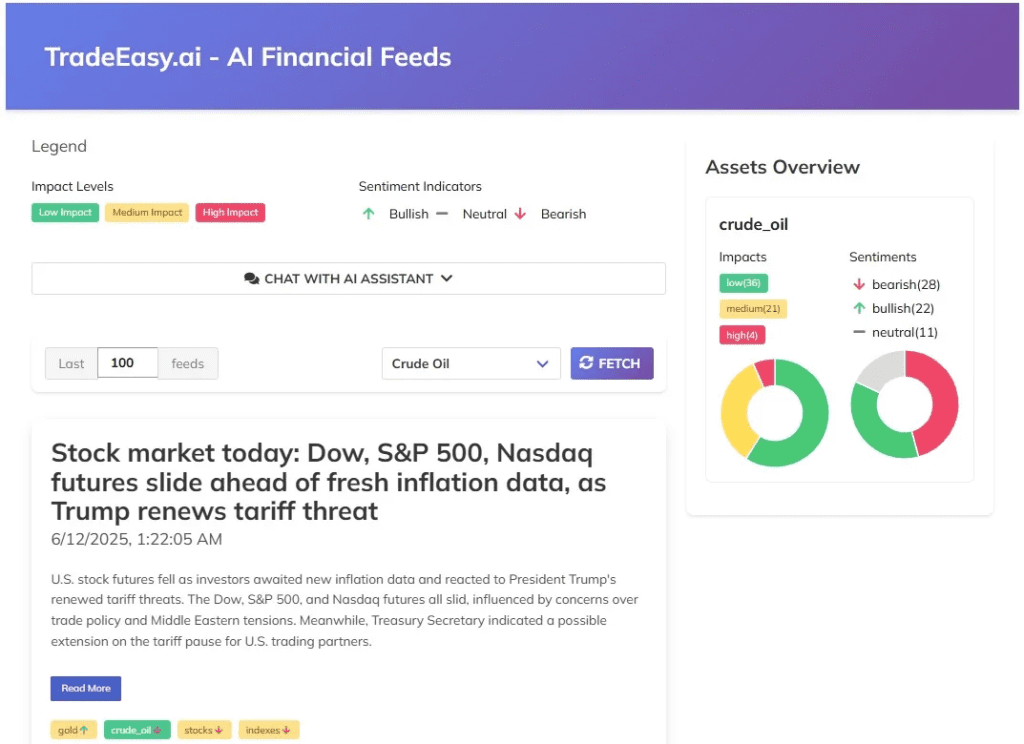
TradeEasy.ai revolutionizes trading by focusing on market narrative understanding rather than traditional technical analysis. This groundbreaking platform aggregates real-time financial news from premium sources across all major asset classes and applies sophisticated AI analysis to decode market sentiment and potential impact.
Core Intelligence Features:
- Comprehensive News Monitoring: Real-time aggregation from trusted financial sources across stocks, bonds, commodities, forex, and cryptocurrencies
- Advanced Sentiment Engine: AI-powered classification of news as “Bullish,” “Neutral,” or “Bearish” with contextual understanding
- Impact Prediction System: Automated assessment of news significance rated as “Low,” “Medium,” or “High” market impact
- Interactive AI Assistant: Conversational interface providing market insights and trend explanations based on current news flow
What Sets TradeEasy.ai Apart: Unlike conventional trading tools that rely primarily on price patterns and technical indicators, TradeEasy.ai empowers traders by revealing the fundamental stories driving market movements. The platform’s AI assistant delivers contextual market intelligence while maintaining clear boundaries against providing specific investment advice.
Key Benefits:
- Asset dashboard showing sentiment trends across multiple markets
- Intelligent news summarization with actionable insights
- Market narrative analysis for understanding price movements
- Cross-asset coverage providing comprehensive market view
Pricing: Free access through Developer website
Best Suited For: Traders seeking fundamental market understanding, news-driven trading strategies, and comprehensive market intelligence
2. TrendSpider – Automated Technical Analysis Excellence
TrendSpider specializes in automating complex technical analysis through AI-powered chart pattern recognition and multi-timeframe analysis. The platform automatically identifies trading patterns, draws trendlines, and provides comprehensive backtesting capabilities without requiring programming skills.
Key Features: Multi-timeframe scanning, automated pattern recognition, visual strategy builder Pricing: $107-$447 monthly with trial options Ideal For: Technical traders seeking automation and pattern-based strategies
3. Trade Ideas – AI-Powered Signal Generation
Trade Ideas leverages its proprietary “Holly” AI system to analyze millions of potential trades daily, delivering high-probability opportunities with specific entry and exit recommendations. The platform excels in day trading applications with real-time scanning and automated execution capabilities.
Standout Features: AI trade recommendations, live trading community, automated broker integration Pricing: $89-$228 monthly with free basic access Best For: Active day traders requiring rapid signal generation
4. StockHero – User-Friendly Automation Platform
StockHero simplifies trading automation through its no-code interface and bot marketplace. Users can create custom trading strategies or rent proven bots from other traders, making advanced automation accessible to non-technical users.
Core Offerings: Bot marketplace, visual strategy creation, paper trading Pricing: Free tier available, premium plans $29-$99 monthly Target Users: Beginner to intermediate traders seeking easy automation
5. Kavout – AI-Driven Stock Analysis
Kavout employs machine learning to analyze stocks using its proprietary scoring system, evaluating over 200 factors including fundamental metrics, technical indicators, and sentiment analysis to identify promising investment opportunities.
Primary Features: Stock scoring algorithm, portfolio optimization, strategy backtesting Pricing: Plans starting at $20 monthly
Best Match: Long-term investors focused on fundamental analysis
6. 3Commas – Cryptocurrency Automation Specialist
3Commas focuses exclusively on cryptocurrency trading automation, offering sophisticated bots for dollar-cost averaging (DCA), grid trading, and portfolio management across multiple exchanges.
Crypto Features: DCA bots, grid trading, smart trading terminal, mobile application
Pricing: Subscription-based with performance tiers
Designed For: Cryptocurrency traders seeking 24/7 automation
7. Cryptohopper – Social Crypto Trading Platform
Cryptohopper combines automated trading with social features, allowing users to copy successful traders’ strategies or purchase trading signals from marketplace providers.
Social Elements: Strategy marketplace, copy trading, visual designer
Pricing: Multiple subscription tiers based on features Target Market: Social crypto traders and strategy followers
8. WunderTrading – Advanced Crypto Algorithms
WunderTrading provides sophisticated cryptocurrency trading algorithms with copy trading capabilities and advanced risk management features designed for serious crypto traders.
Advanced Tools: Complex algorithms, copy trading, script integration
Pricing: Performance-based and subscription options
Suited For: Advanced cryptocurrency traders
9. Bitsgap – Multi-Exchange Crypto Trading
Bitsgap specializes in arbitrage and grid trading across multiple cryptocurrency exchanges, providing tools for taking advantage of price differences and market inefficiencies.
Specialized Features: Arbitrage scanner, grid trading, multi-exchange support
Pricing: Tiered subscription model
Best For: Crypto arbitrage and grid trading strategies
10. Tickeron – Pattern Recognition Technology
Tickeron focuses on chart pattern identification and predictive analytics, offering AI-powered pattern recognition with confidence scores and historical performance data.
Pattern Analysis: Over 40 pattern types, confidence scoring, community features
Pricing: Free basic access, premium at $250 monthly
Ideal Users: Pattern traders and technical analysis enthusiasts
Comprehensive Comparison Table
| Platform | Primary Focus | Key Strength | Pricing Range | Free Option |
| TradeEasy.ai | News Intelligence | Market narrative analysis | Free | Yes |
| TrendSpider | Technical Analysis | Automated charting | $107-$447/month | 7-day trial |
| Trade Ideas | Stock Signals | AI trade generation | $89-$228/month | Basic features |
| StockHero | Easy Automation | No-code bot creation | $0-$99/month | Yes |
| Kavout | Stock Analysis | AI scoring system | $20+/month | Trial available |
| 3Commas | Crypto Bots | DCA/Grid trading | Variable | Limited free |
| Cryptohopper | Social Crypto | Strategy marketplace | Tiered | Basic plan |
| WunderTrading | Advanced Crypto | Complex algorithms | Variable | Trial |
| Bitsgap | Crypto Arbitrage | Multi-exchange trading | Subscription | Limited |
| Tickeron | Pattern Recognition | Chart analysis | Free-$250/month | Yes |
Understanding AI Trading Technology
AI trading tools represent sophisticated software systems that utilize artificial intelligence and machine learning algorithms to analyze financial markets. Unlike traditional trading bots that operate on fixed rules, modern AI trading platforms continuously learn from market data, adapting their strategies as conditions evolve. These systems process multiple data sources simultaneously, including price movements, trading volumes, financial news, earnings reports, and social media sentiment.
The core advantage of AI trading tools lies in their ability to identify patterns and correlations that human traders might miss or take too long to recognize. When the AI detects a significant pattern or market signal, it can either provide trading recommendations or automatically execute trades based on predetermined parameters.
How AI Trading Systems Operate
AI trading platforms function through complex algorithms that continuously monitor vast amounts of market data. This includes traditional financial metrics like price and volume, as well as alternative data sources such as news sentiment, social media discussions, and economic indicators. The AI systems analyze this information to identify trading opportunities and predict potential market movements.
Advanced platforms can execute trades automatically when specific conditions are met, enabling traders to capitalize on brief market opportunities even when they’re not actively monitoring the markets. The machine learning components of these systems improve over time, learning from both successful and unsuccessful trades to refine their strategies.
Categories of AI Trading Solutions
The AI trading landscape encompasses various specialized tools designed for different trading styles and asset classes:
Market Analysis Tools: These platforms focus on providing insights and signals rather than executing trades, helping traders make informed decisions.
Automated Trading Bots: Full automation systems that can execute trades based on AI-generated signals and predefined strategies.
Portfolio Management Systems: AI-powered tools that optimize portfolio allocation and rebalancing based on market conditions and risk parameters.
Backtesting Platforms: Systems that allow traders to test strategies against historical data before implementing them with real capital.
Specialized Asset Tools: Platforms designed specifically for particular markets like stocks, cryptocurrencies, forex, or options.
Key Advantages of AI Trading Technology
Enhanced Processing Speed and Accuracy
AI trading tools can analyze thousands of data points simultaneously, identifying opportunities far faster than human analysis. This speed advantage is crucial in markets where opportunities may exist for only seconds or minutes.
Emotion-Free Decision Making
One of the most significant benefits of AI trading is the elimination of emotional decision-making. Fear, greed, and other emotions often lead to poor trading decisions. AI systems execute trades based purely on data and predetermined strategies, maintaining consistency regardless of market volatility.
Continuous Market Monitoring
AI trading systems can monitor markets 24/7, ensuring no opportunities are missed due to time zone differences or trader availability. This is particularly valuable in cryptocurrency markets that never close.
Advanced Pattern Recognition
Machine learning algorithms excel at identifying complex patterns in large datasets that might be invisible to human analysis. These patterns can reveal profitable trading opportunities that traditional methods might overlook.
Automated Risk Management
AI systems can implement sophisticated risk management protocols automatically, including position sizing, stop-loss orders, and portfolio diversification, helping protect against significant losses.
Potential Risks and Considerations
Technology Dependence and System Failures
AI trading systems rely on technology infrastructure that can experience failures, connectivity issues, or data feed problems. These technical issues can result in missed opportunities or unexpected trading behavior.
Algorithm Transparency Challenges
Many AI trading systems operate as “black boxes,” making decisions through complex algorithms that may be difficult to understand or predict. This lack of transparency can make it challenging to anticipate how the system will react to unusual market conditions.
Data Quality and Bias Issues
AI systems are only as good as the data they’re trained on. Biased or incomplete data can lead to flawed decision-making and potentially risky trading strategies.
Market Anomaly Limitations
AI systems may struggle to adapt to unprecedented market events or “black swan” situations that fall outside their training data. Human oversight remains crucial during periods of extreme market volatility or unusual events.
Regulatory and Compliance Considerations
Automated trading systems must comply with various financial regulations, and traders using these tools are responsible for ensuring their activities meet all applicable legal requirements.
Strategic Selection Guidelines
Assess Your Trading Style and Goals
Consider your trading frequency, preferred markets, and risk tolerance when selecting an AI trading tool. Day traders may prioritize speed and signal generation, while long-term investors might focus on fundamental analysis and portfolio optimization.
Evaluate Technical Requirements
Determine whether you prefer user-friendly interfaces with minimal technical requirements or more sophisticated platforms that offer greater customization options. Consider your comfort level with technology and your desire for hands-on control versus automation.
Market Coverage and Integration
Ensure your chosen platform supports the markets and assets you want to trade. Verify that the tool integrates seamlessly with your preferred brokers or exchanges and provides reliable data feeds.
Cost-Benefit Analysis
Compare the costs of different platforms against their potential benefits. Consider not just subscription fees but also any performance-based charges, broker integration costs, and the time investment required to learn and optimize the system.
Security and Reliability
Prioritize platforms with strong security measures, including encryption, two-factor authentication, and secure API connections. Research the platform’s uptime record and customer support quality.
Best Practices for AI Trading Success
Start with Backtesting and Paper Trading
Before risking real capital, thoroughly test any AI trading strategy using historical data and paper trading accounts. This helps you understand how the system performs under different market conditions without financial risk.
Maintain Diversification
Don’t rely solely on a single AI trading tool or strategy. Diversify across different platforms, strategies, and asset classes to spread risk and reduce dependence on any single system.
Regular Performance Monitoring
Continuously monitor your AI trading system’s performance and be prepared to make adjustments as market conditions change. Set clear performance benchmarks and review results regularly.
Stay Informed and Educated
Keep up with developments in AI trading technology and market conditions. Understanding how your tools work and staying informed about market trends will help you make better decisions about when and how to use automation.
Implement Proper Risk Management
Establish clear risk parameters and ensure your AI trading systems adhere to them. This includes setting position size limits, stop-loss levels, and maximum drawdown thresholds.
Frequently Asked Questions
Q: Can AI trading tools guarantee profits? A: No AI trading tool can guarantee profits. While these systems can improve analysis and execution efficiency, they cannot eliminate market risk or predict all market movements. Success depends on proper implementation, ongoing monitoring, and sound risk management.
Q: Are AI trading platforms safe to use? A: Reputable AI trading platforms implement strong security measures, but risks always exist. Research platforms thoroughly, use secure authentication methods, and only grant necessary permissions to trading bots. Never share withdrawal access with automated systems.
Q: What’s the best AI trading tool for beginners? A: Beginners should consider user-friendly platforms like TradeEasy.ai for market intelligence, StockHero for simple automation, or platforms with strong educational resources and paper trading capabilities. Start with demo accounts before risking real money.
Q: How much does AI trading software typically cost? A: Costs vary widely, from free basic versions to premium subscriptions costing hundreds per month. Many platforms offer tiered pricing based on features and performance. Consider starting with free or low-cost options to test compatibility with your trading style.
Q: Do I need programming skills to use AI trading tools? A: Many modern AI trading platforms are designed for non-technical users and require no programming knowledge. However, some advanced platforms offer additional customization options for users with coding skills.
Conclusion: The Future of AI-Enhanced Trading
AI trading tools represent a significant evolution in financial markets, democratizing access to sophisticated analysis and automation capabilities previously available only to institutional traders. These platforms offer substantial advantages in terms of speed, accuracy, and emotion-free decision-making, but they require careful selection, proper implementation, and ongoing management.
Success with AI trading tools comes from understanding their capabilities and limitations, implementing proper risk management, and maintaining an active role in strategy oversight. As these technologies continue advancing, traders who effectively integrate AI assistance with fundamental market knowledge and disciplined risk management will be best positioned to capitalize on market opportunities.
The key to successful AI trading lies not in finding a perfect system, but in selecting tools that align with your trading goals, learning to use them effectively, and maintaining the discipline to adapt as markets and technologies evolve.

